
Universal Joints: The Key to Your Car's Performance on Bumpy Roads
Ever hit a pothole and marveled at how your car’s wheels stay connected to the driveline? You can thank universal joints—or u-joints—for that magic. These unassuming parts act like flexible hinges in your driveline system, letting the driveshaft twist and tilt as suspension moves. Without them, every bump would send jolts through your transmission, turning a smooth ride into a shaky ordeal.
The Hidden Hero: How U-Joints Keep Power Flowing
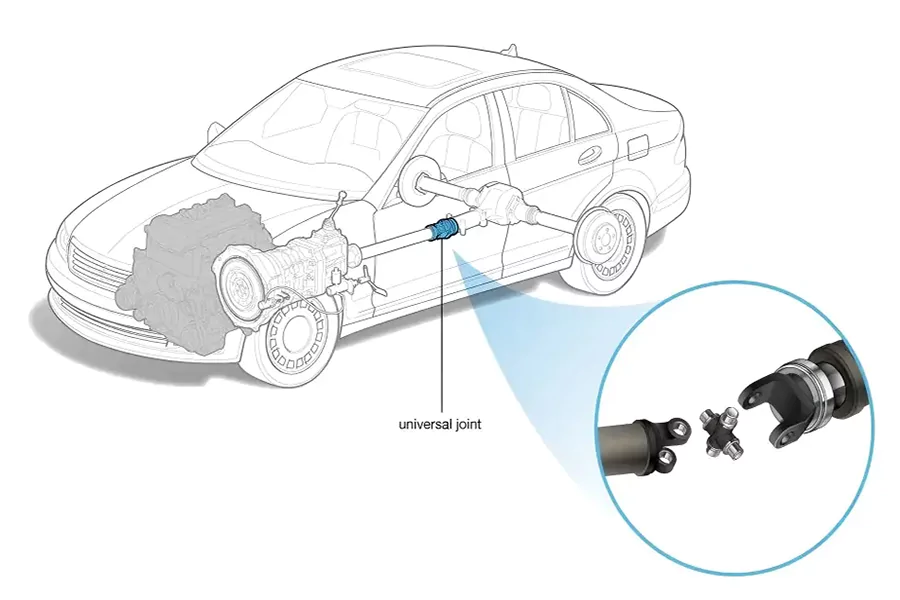
A universal joint has an X shaped core that connects two yokes. At each end of the X shaped core, needle bearings are installed, which enable the joint to rotate in multiple directions. This clever setup absorbs vibrations and adjusts to shifting angles as your suspension compresses. Whether you’re accelerating uphill or crawling over gravel, these rugged u-joints maintain a steady transfer of engine power to the wheels. Most rear-wheel-drive vehicles rely on pairs of them at both ends of the driveshaft, working silently behind the scenes.
Though all u-joints solve the same problem—flexible power transfer—their engineering varies. Take the classic cross-type universal joint, for instance. Its interlocking yokes and solid crosspiece prioritize strength, making it a go-to for trucks and heavy-duty vehicles. But efficiency isn’t its strong suit. For lighter applications, the ring-type joint swaps the cross for rubber or layered steel discs. It’s space-saving and doesn’t need grease, though the trade-off is reduced longevity.
Innovation doesn’t stop there. Need a joint that both bends and slides? The ball trunnion u-joint uses spherical bearings to handle complex movements, perfect for steering systems. And if you drive a front-wheel-drive car, your axle likely uses constant velocity (CV) joints. These advanced u-joints maintain consistent rotational speed between shafts, preventing wheel hop during sharp turns—a common issue with older universal joint designs.
Why Maintenance Matters
A well-designed universal joint balances durability with adaptability. The cross-type’s needle bearings, for example, let it handle abrupt angle changes without binding. But like all mechanical parts, wear takes its toll. Off-road driving or corroded seals can grind down bearings, leading to telltale clunks or vibration under acceleration. Catching these signs early saves you from costly driveshaft repairs down the road.
From rugged cross-types to precision CV joints, universal joints are the unsung heroes of vehicle dynamics. They transform rigid drivelines into responsive systems that eat bumps for breakfast. Next time you navigate a construction zone or winding backroad, remember: those humble u-joints are what let your car dance across imperfections while keeping you firmly in control.
What makes universal joints so versatile? It’s all in the engineering. The cross-type u-joint, for example, uses precision bearings to let yokes pivot smoothly around its arms. This setup absorbs vibrations while accommodating driveline angles that change as suspension compresses over bumps. The result? A seamless transfer of rotational force, even when your wheels are dancing over potholes.
Though robust, u-joints aren’t indestructible. Harsh conditions or worn bearings can lead to play in the joint, causing clunking noises or driveline shudder. Regular inspections help catch issues early, as a failing universal joint can leave you stranded—or damage the driveshaft itself.
In conclusion
From rugged cross-type designs to advanced CV joints, universal joints bridge the gap between raw power and smooth motion. Next time you drive down a rough road, remember: those unassuming u-joints are working overtime to keep your ride stable and responsive. Understanding their role not only helps appreciate your vehicle’s engineering but also underscores why timely maintenance matters for safety and performance.