
How Much Does a Driveshaft Replacement Cost? Factors That Affect Price
Nobody gets a quote on a driveshaft problem before they get a symptom.
A vibration that comes up through the floor pan. A clunk when the shifter drops from reverse into drive. A squeak that keeps getting louder the faster you go. Then the question lands: how much does a driveshaft replacement cost?
The honest answer runs from the price of a single U-joint to the price of a complete assembly, and the spread between those two numbers is the point of this article. Which part let go, what it’s bolted to, and how long the driver kept going with the noise all land on the final invoice.
What Does a Driveshaft Actually Do?
Prop shaft, propeller shaft, or driveshaft, depending on which market you’re buying in. Same part.
It carries torque from the transmission or transfer case back to the differential, and from there out to the driven wheels. Torque, load, and rpm all work on it at the same time, so a small defect turns into a noise or a vibration long before it turns into a breakdown.
Most rear-wheel-drive vehicles run a U-joint at each end, which is what lets the shaft work through the movement between transmission output and rear end. Longer or two-piece shafts add a center support bearing to hold the middle. Four-wheel-drive and AWD vehicles often carry more than one shaft.
So “driveshaft replacement” covers two very different jobs: swapping one serviceable part, or replacing the whole assembly.
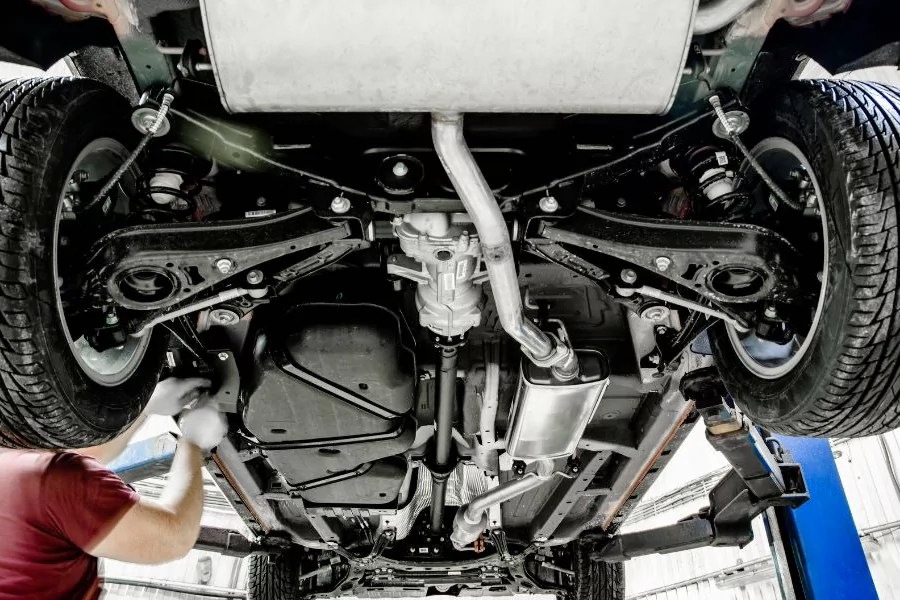
How Much Does Driveshaft Replacement Cost?
There’s no single number, because it isn’t a single job.
Start at the component level. RepairPal currently estimates a U-joint replacement at about 331to331to406, and a carrier bearing replacement at about 395to395to517, both figures including parts and labor. Those are repairs to a shaft that’s still straight. Your market rate and the vehicle’s specifics go on top of that.
Which brings up the first question worth answering: is the shaft itself damaged, or did a part bolted to it fail?
If the U-joint is dry, pitted, or knocking and the tube is straight, you replace the joint. If the tube is bent, a weld is cracked, the balance weights are gone, or runout measures past spec, the shaft is finished, and new joints won’t save it. OE service information uses exactly those two checks, runout measurement and a physical damage inspection, to decide whether a prop shaft gets replaced.
What Actually Moves the Price
Assembly or a single part?
This is usually the whole difference. An assembly is the tube, both U-joints, the yokes, the flanges, the splined sections, and the center support bearing. One failed part on a shaft designed to be serviced means one part. The catch is that plenty of shafts aren’t designed that way. Staked-in U-joints on some applications were never meant to come out, and on those the whole shaft gets replaced whether you wanted that or not.
Vehicle make and model
A compact car, a pickup, an SUV, and a commercial truck don’t share shaft lengths, tube diameters, spline counts, yoke styles, or balance specs. A one-piece steel shaft and a two-piece aluminum shaft for the same body style can price out hundreds apart. Searching “drive shaft price” and stopping there gets you the wrong number and quite possibly the wrong part. Pull the OE reference and confirm the exact application first.
OEM or aftermarket
OEM comes from the original application. Fitment is easy to confirm and the price is easy to predict: high. Aftermarket driveshaft parts cover the other route, and for a shop or a distributor working across many applications, they’re often the only practical way to buy. That means U-joints, yokes, flanges, splined sleeves, and center support bearings bought as individual pieces instead of a complete assembly every time.
Cheapest isn’t the filter. Dimensional accuracy, material, balance quality, and correct fitment are the filter. A U-joint that’s half a millimetre out on the trunnion diameter will eat itself inside one season.
Labor and diagnosis
Shop rates swing hard between markets, and the job isn’t uniform either. Dropping a complete shaft can mean working at the transmission or transfer case end, supporting the driveline properly, and reinstalling to the manufacturer’s procedure. Some vehicles need driveline angle checked on the way back in.
Diagnosis is billable time too. A technician following a published service procedure will check the shaft for dents, missing balance weights, and excessive runout before anyone orders a part. An NHTSA-published technical service procedure calls out those exact checks. Skipping them is how a shop ends up replacing the wrong thing and eating the comeback.
Whatever else let go
Bad parts rarely travel alone. A worn U-joint that’s been hammering for months takes the yoke with it. A collapsed carrier bearing lets the shaft whip, and the whipping finishes off the rear joint. A truck driven hard on a bad shaft can need the pinion seal, the output bushing, and a rebalance on top of the original repair.
A cheap parts quote can still turn into an expensive repair order.
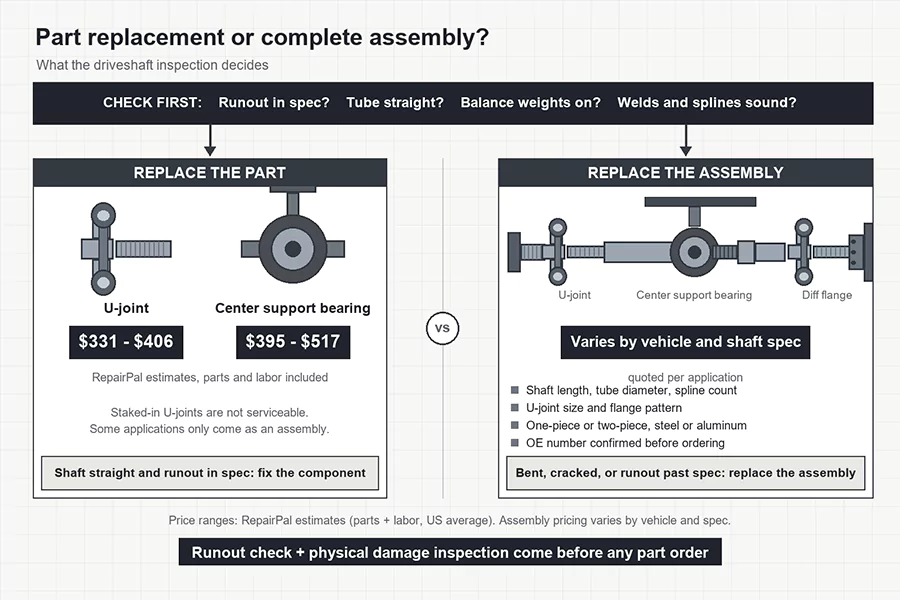
Can a Driveshaft Be Repaired Instead of Replaced?
Often, yes.
If the tube is structurally sound and the failure is confined to a serviceable item, repairing beats replacing. The usual candidates: U-joints, center support bearings, yokes, flanges, and splined components. A driveline shop can press in new joints, swap a yoke, and rebalance the shaft for a fraction of an assembly.
A bent or badly damaged shaft is the other case entirely. Runout out of spec, cracked or dented tubing, missing weights, twisted splines. Those change how the whole driveline behaves, and no rebalance brings it back. Replace the assembly.
Choosing Replacement Driveshaft Parts
For workshops, distributors, and importers, the hard part usually isn’t finding a driveshaft. It’s finding the right one for the application at a cost that still leaves margin.
That means confirming the OE number, tube length and diameter, spline spec, U-joint size, flange pattern, and vehicle compatibility before the order goes out. Get one of those wrong and the part comes back, and so does the freight bill.
HZSP, operated by Hangzhou Speedway Import and Export Co., Ltd., supplies automotive driveshaft parts and complete driveline assemblies to B2B customers internationally. The range covers universal joints, end yokes, slip yokes, weld yokes, flange yokes, stub shafts, splined sleeves, center support bearings, and complete driveshaft assemblies.
HZSP has been in driveline supply for over 25 years, and runs dimensional inspection, hardness and torque testing, and fatigue testing across its products. The company holds ISO/TS 16949:2009 and ISO 9001 certification along with CE marking, with the 16949 certificate written against the automotive quality spec that IATF 16949 later replaced.
When you’re comparing driveshaft replacement costs, price the failed component before you price the whole assembly. Whether the cheaper route makes sense comes down to the vehicle, the failed part, and the condition of the shaft already under the truck. Know what needs to come off, and comparing the right parts gets a lot easier than comparing the lowest prices.