
Common Signs of End Yoke Wear
Let’s be real — nobody crawls under their truck hoping to find a worn end yoke. But here’s the thing about driveline components: they don’t always fail dramatically. They wear. Slowly. Quietly. And by the time most people notice something’s wrong, the wear may have been developing for a while.
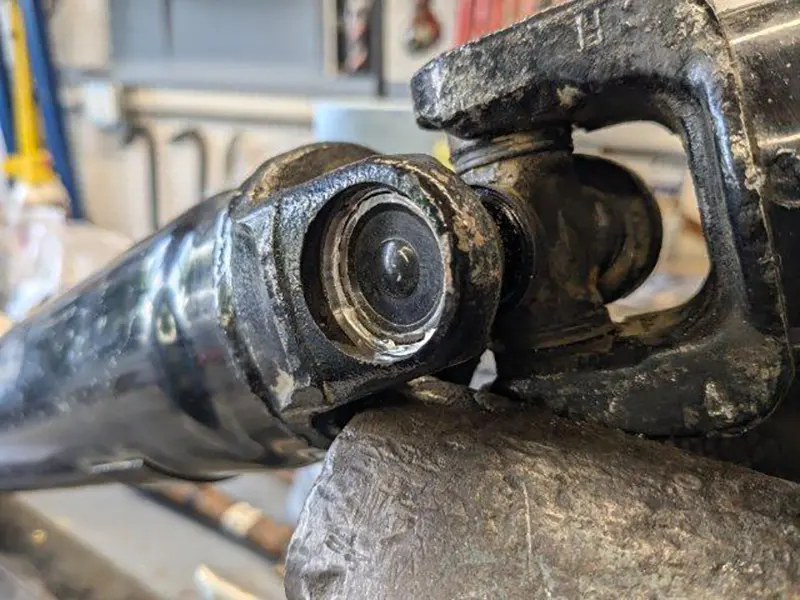
An end yoke can look fine on the outside but be worn so badly that the U-joint caps no longer fit securely in their seats. Cracks can also develop around the yoke ears without being immediately obvious. The trick is catching the wear before it becomes a failure. Here’s what to look for.
Vibration You Can't Explain
This is usually one of the first things that sends people looking. A vibration that shows up at highway speed, or one that comes and goes depending on load. You’ve had the tires balanced. You’ve checked the U-joints. Everything “looks” fine. But that vibration is still there.
A worn end yoke can allow the U-joint bearing caps to move in their seats. The amount of movement may be small, but excessive looseness in the driveline can contribute to vibration, especially when combined with other problems such as driveshaft imbalance or incorrect operating angles.
Dana/Spicer service documentation identifies excessive looseness in universal joint assemblies as a potential cause of driveshaft imbalance and vibration. However, vibration alone doesn’t confirm that the end yoke is worn. Other driveline components and installation conditions need to be checked before identifying the cause.
If you’ve eliminated everything else and the vibration persists, inspect the yoke and its connections for abnormal movement. Any movement beyond the manufacturer’s specified limits needs further investigation.
Squeaking or Chirping That Changes with Speed
A squeak that tracks with vehicle speed — rather than engine RPM — can be a sign of a U-joint or another driveline problem. It might be faint at first. Maybe you only hear it pulling out of the driveway. But it gets louder.
Here’s what may be happening: worn or poorly lubricated universal joint bearings can create noise as the driveline rotates. Damaged bearing caps, loose connections, or wear around the yoke’s bearing seats may also be involved.
Don’t ignore it. A squeak or chirp is a reason to inspect the driveline, but it doesn’t automatically mean the end yoke itself has failed. Check the universal joint, lubrication condition, bearing-cap fit, and retaining hardware to identify the actual source.
Looseness You Can Feel by Hand
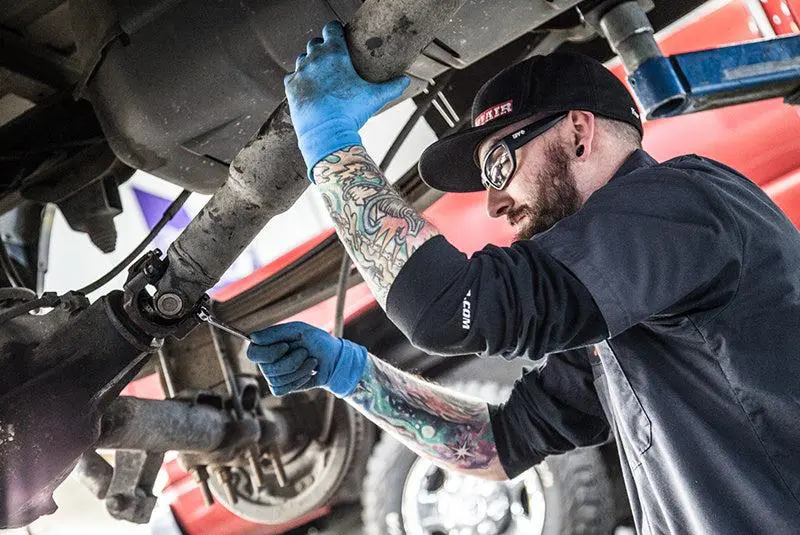
This is the check that helps separate a possible problem from one that needs further investigation. With the vehicle properly secured and the driveline supported according to the manufacturer’s service procedure, inspect the end yoke and its connections for abnormal movement.
A healthy yoke should be securely fitted to its mating components. The acceptable amount of movement, however, depends on the design and the location being checked.
If you feel play, don’t automatically assume the yoke itself is worn. The retaining nut could be loose. The connection between the yoke and shaft could be damaged. The splines could be worn, or the movement could originate in the connected transmission, axle, or transfer case.
The Dana Spicer 10 Series Driveshaft Service Manual includes end fitting inspection procedures and recommends contacting the original-equipment manufacturer’s service documentation when end fitting looseness is found on a shaft. When looseness is apparent between the nut, yoke or center bearing, more inspection is required.
The next step is dependent on the application. Before installing the new yoke, inspect the retaining hardware, splines, mating surfaces, and attached components against the applicable service specifications.
Cracks — Especially Around the Bearing Saddles
This one’s the serious one. A cracked yoke doesn’t always announce itself with a noise or a vibration. Sometimes it just breaks.
Inspect the yoke’s bearing saddle area carefully. Look for hairline cracks around the cross holes, strap mounting holes, and the yoke ears where the bearing caps seat. Any crack should be treated as a serious defect, and the component should be replaced in accordance with the manufacturer’s service instructions.
Dana/Spicer’s driveshaft service documentation identifies damaged end-fitting components as requiring replacement and states that a yoke should be replaced when inspection reveals specified forms of damage or distortion.
Welding a cracked yoke back together is not a repair to recommend without explicit manufacturer approval. The suitability of a repair depends on the component’s material, design, heat treatment, and approved repair procedures. For a cracked yoke, replacement with the correct part is the safer course.
Wear Patterns in the Bearing Saddles
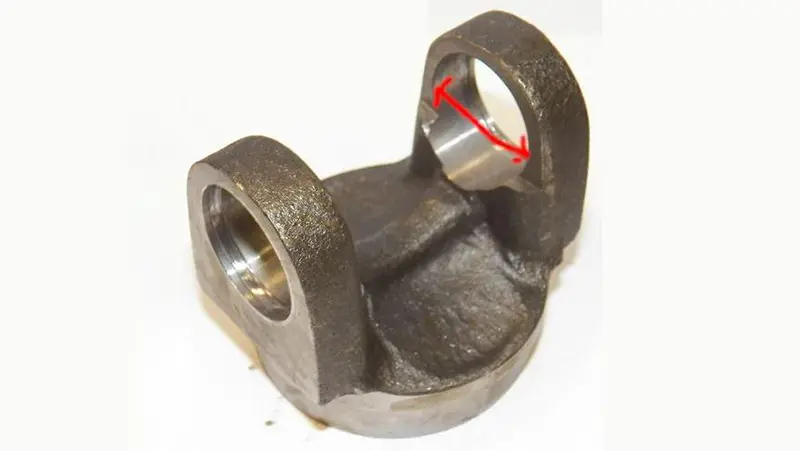
Even if there’s no visible crack and no obvious looseness, look at the bearing saddles themselves. The surfaces where the U-joint caps contact should be good and within dimensional specifications from the manufacturer. If you see gouging, galling, fretting or a “stepped” look, the yoke may have moved or made too much contact.
This type of wear can be caused by running a U-joint dry or from repeated torque cycles on a loose or poorly fitted connection.
Dana/Spicer’s service manual instructs technicians to inspect yoke cross-hole surfaces for damage or raised metal. It also warns that distorted cross holes can cause premature cross and bearing problems. If the specified inspection procedure confirms that the yoke is distorted, replacement is required.
Once those saddles are worn beyond specification, no new U-joint is going to restore the original fit. You can install new bearings, but they won’t correct a damaged yoke. The looseness may remain, and vibration or premature wear can return. Replace the yoke if it fails the manufacturer’s inspection criteria.
The Bottom Line
End yoke wear is one of those things that’s easy to miss until it’s expensive to fix. The signs are there — vibration, noise, looseness, cracks — but you have to actually look.
A useful approach is to inspect the yokes and their connections whenever the vehicle is already being serviced. Inspect for abnormal movement, damaged bearing seats, cracks and loose retaining hardware. If it looks or feels wrong, compare it to the relevant service specs, rather than guessing.
Replacement yoke can cost some money, but so can a failed drive line. Timely detection of wear and installation of the right replacement can help avoid repeat repairs and keep the vehicle working reliably.