4 Types of Universal Joints Used in Automotive Applications
Let’s face it, most folks don’t give a thought to their universal joints until something goes awry. And, when it does, the symptoms are usually the same: a vibration you can feel through the floor, a clunk when you go to put the car in gear, or a shudder that appears at precisely the wrong speed. The U-joint is one of those parts that doesn’t get a lot of attention until it needs it.
But here’s the thing: U-joints aren’t all created equal. They are built for different tasks and knowing what type does what can save you from chasing the wrong fix.
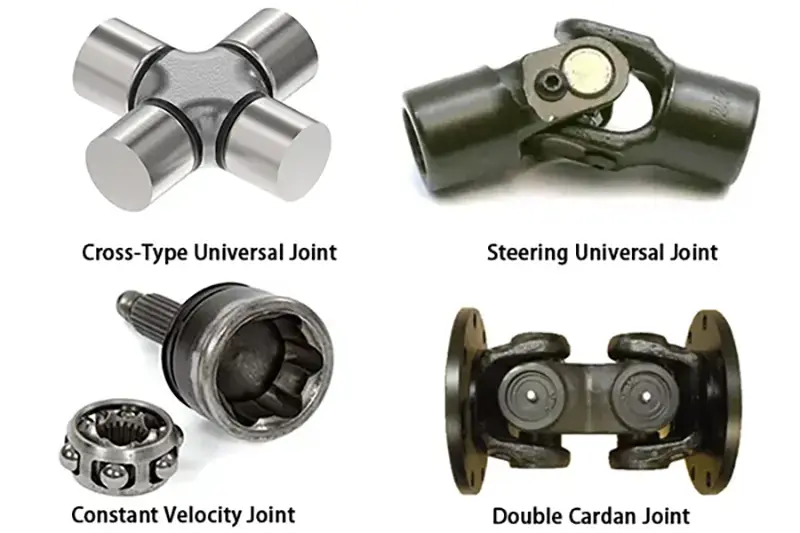
Cross-Type Universal Joint
This is the one most people picture when they hear “U-joint.” A four-point cross trunnion — the spider — sits between two yokes, with needle roller bearings on each arm to handle the rotation. It’s simple, brutally strong, and cheap to manufacture.
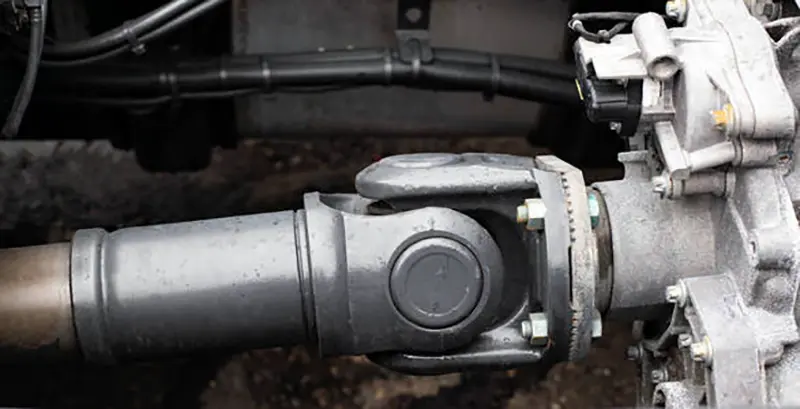
You’ll find it in rear-wheel-drive propshafts, driveshafts on trucks, and just about anywhere a single shaft needs to transmit torque through a mild angle. The cross-type’s weakness is that it doesn’t rotate at constant velocity. When the joint is bent, the output shaft speeds up and slows down twice per revolution. That’s why driveshaft angles matter so much — the second U-joint at the other end has to cancel out that fluctuation, or you get vibration.
If a cross-type joint fails, it usually announces itself with a rhythmic squeak or chirp that changes with speed. By the time it starts clunking, the needle bearings are already gone.
Constant Velocity Joint (CV Joint)
Front-wheel-drive cars couldn’t exist without CV joints. When your wheels are doing the steering and the driving at the same time, the joint has to handle angles that a cross-type simply can’t manage without shaking the whole car apart.
CV joints come in several flavors — Rzeppa, cross-groove, tripod — but they all share the same principle: a cage holds a set of ball bearings between an inner race and an outer housing. The balls ride in precision-machined grooves that keep the input and output shafts turning at exactly the same speed, even at steep angles.
The tradeoff is complexity. CV joints are expensive, sensitive to contamination, and absolutely dependent on their rubber boots staying intact. Once a boot tears and grease escapes, grit gets in, and the joint destroys itself in short order. That clicking sound when you turn the wheel? That’s your warning shot.
Double Cardan Joint
A double Cardan is essentially two cross-type joints married together with a centering ball between them. The two joints work as a pair to cancel out each other’s velocity fluctuations, delivering near-constant velocity without the complexity of a true CV joint.
This design shows up on lifted trucks, off-road rigs, and anything running a steep driveshaft angle where a single U-joint would vibrate itself to death. It’s the workhorse solution for modified drivelines — not as smooth as a CV, but far more robust when you’re crawling over rocks or blasting through whoops.
The centering ball is the weak point. It needs grease, and when it dries out, the joint develops a vibration that’s hard to diagnose because everything else checks out fine.
Steering Universal Joint
Steering U-joints are a different animal entirely. They live inside the steering column, connecting the shaft segments between the steering wheel and the rack or gearbox. Loads are lower here, but the consequences of failure are obviously catastrophic.
These joints tend to be smaller and lighter than driveline U-joints, often with sealed bearings and anti-backlash features to keep steering feel tight. Some use spherical heads and sockets rather than the traditional cross-and-yoke arrangement. They also have to accommodate the collapsible safety features built into modern steering columns — absorbing energy in a crash without jamming the wheel.
When a steering U-joint goes bad, you’ll feel it as a loose spot or a bind when turning. That’s not something you ignore.
The Bottom Line
Cross-type joints are the simple, tough standard for rear-drive applications. CV joints handle the extreme angles of front-wheel drive. Double Cardans bridge the gap for lifted and modified vehicles. Steering U-joints do a quieter job with much higher stakes.
Match the joint to the application, keep them greased, and they’ll outlast the vehicle. Ignore the early symptoms, and you’ll be replacing more than just the joint.