
Fixed Yoke vs Slip Yoke: What’s the Difference in a Driveshaft?
Drivers’ a driveshaft looks to be a simple component, but, in fact, it is comprised of a few parts that work together to transfer power from the transmission to the axle. One of those parts, the yoke, is used to connect the driveshaft to other drivetrain parts and provide reliable transmission of torque.
Fixed yokes and slip yokes are two types of yokes you are likely to find in a driveshaft. Although they serve the same purpose of providing power transmission through the driveline, they are quite different.
Knowing how these two yoke types are different will help with driveshaft inspections, selection of replacement parts, and troubleshooting drivetrain complaints.
What Is a Fixed Yoke?
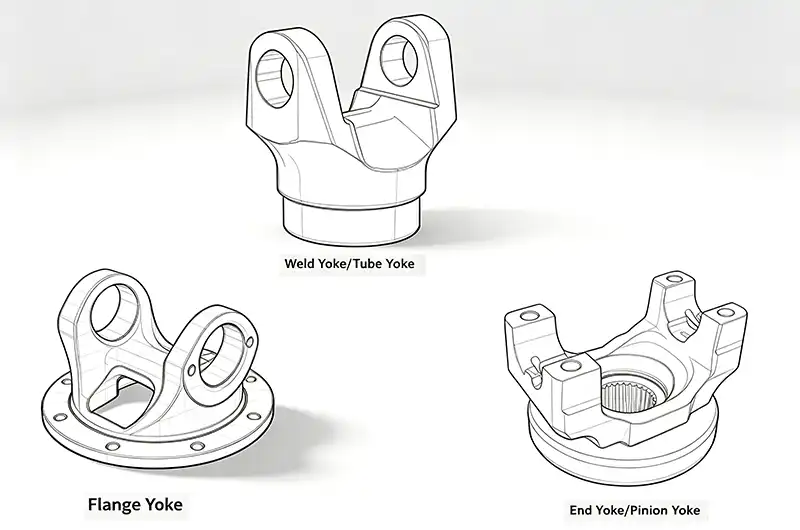
A fixed yoke is a driveshaft yoke designed to maintain a fixed axial position during operation. It connects the driveshaft with another drivetrain component, often through a universal joint, and transfers engine torque through the driveline.
The term “fixed” mainly refers to its axial movement. Unlike a slip yoke, a fixed yoke is not designed to slide in and out to compensate for changes in driveshaft length.
Fixed yokes are commonly found in different parts of a driveshaft assembly, depending on the vehicle’s drivetrain design. They can be used with universal joints, flange connections, or other fixed drivetrain connections.
Their main job is straightforward: provide a secure connection and transfer torque reliably.
What Is a Slip Yoke?
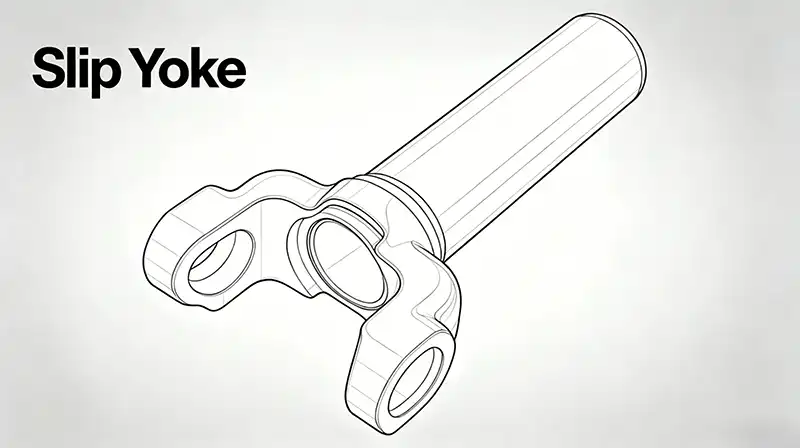
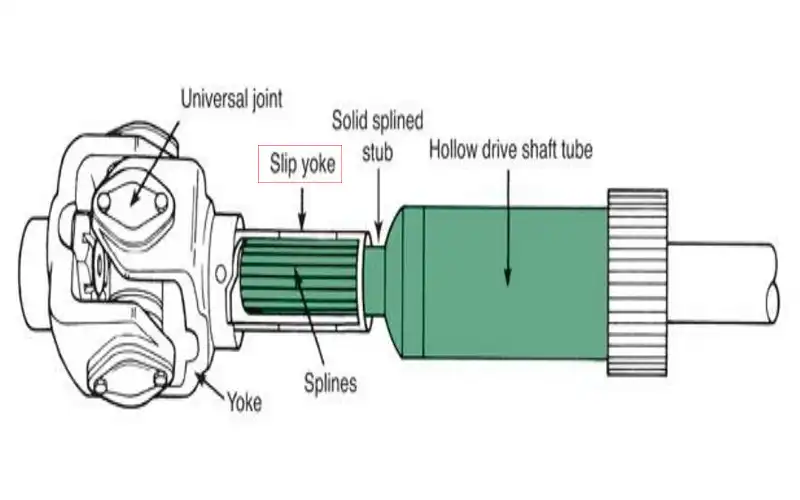
A slip yoke is designed to allow axial movement. It typically slides along a splined shaft, allowing the driveshaft to become slightly longer or shorter as the suspension moves or drivetrain components change position.
This movement is especially important in vehicles with a traditional transmission and rear axle layout.
When the vehicle is moving, the distance between the transmission and rear axle does not remain perfectly constant. Suspension movement can change the operating geometry of the driveshaft. The slip yoke provides the necessary movement to accommodate these changes.
Without this ability, unwanted stress could be placed on the driveshaft, transmission output shaft, or other drivetrain components.
Fixed Yoke vs Slip Yoke: Key Differences
The biggest difference is axial movement.
A fixed yoke maintains its position, while a slip yoke is designed to move along the shaft.
| Feature | Fixed Yoke | Slip Yoke |
|---|---|---|
| Axial movement | Limited / fixed | Designed to slide |
| Main function | Fixed connection and torque transfer | Torque transfer and length compensation |
| Typical design | Solid or fixed connection | Splined sliding connection |
| Common application | Fixed drivetrain connections | Transmission/driveshaft connections |
| Replacement consideration | Yoke dimensions and joint fit | Spline count, diameter and length |
It is important to note that driveshaft layouts vary between vehicles. A yoke that works on one application may not be suitable for another, even if the parts look similar.
Why Does a Driveshaft Need a Slip Yoke?
The slip yoke helps the driveshaft accommodate changes in drivetrain geometry.
For example, when a vehicle travels over uneven roads, the rear axle can move relative to the vehicle body. This changes the effective distance between the transmission and differential.
The slip yoke can move along its splined connection to compensate for this change.
This design also allows the driveshaft to be installed and removed more easily in many applications.
A worn slip yoke, however, can cause problems. Excessive wear around the splines or sealing surface may contribute to vibration, looseness, or fluid leakage at the transmission tail housing.
Common Problems With Fixed and Slip Yokes
Yokes are exposed to torque, vibration, changing loads, and road conditions. Over time, wear can occur.
Common signs of yoke-related problems include:
- Driveshaft vibration
- Clunking when accelerating or decelerating
- Excessive play around the connection
- Worn or damaged splines
- Rust or surface damage
- Unusual noise from the driveline
- Transmission fluid leakage around a slip yoke
A damaged yoke should not be ignored. Continued operation can put additional stress on the universal joint, driveshaft, transmission, or differential.
How to Choose the Right Yoke
Choosing a replacement yoke is not simply a matter of matching the overall appearance. Several measurements and specifications need to be checked.
Depending on the application, these may include:
- Universal joint size
- Spline count
- Spline diameter
- Overall length
- Yoke width
- Bearing cap dimensions
- Bolt pattern or flange dimensions
- Driveshaft tube size
- Vehicle make, model, year, and drivetrain
For a slip yoke, the spline specifications are particularly important because the yoke must correctly match the mating shaft.
For a fixed yoke, the connection type and universal joint dimensions should also be confirmed before ordering.
When possible, comparing the original part number or OE reference with the replacement part can help reduce fitment problems.
Final Thoughts
Fixed yokes and slip yokes both have their place in the driveshaft system, but they solve different problems.
A fixed yoke provides a rigid connection for torque transmission, and a slip yoke allows a controlled amount of axial movement to offset changes in the driveshaft length.
Knowing this difference is useful in inspecting a driveshaft, diagnosing drivetrain problems or when buying replacement parts. The correct yoke needs to be chosen for the application on the vehicle, as well as the actual size and specifications of the original parts.
For replacement work, spending a few minutes to confirm the spline, joint size, dimensions and the type of joint connection will preclude an expensive fitment mistake.