End Yoke vs. Slip Yoke vs. Flange Yoke: Understanding Driveshaft Yokes
When a driveshaft starts rattling and vibrating, the first components that typically get a second glance are U-joints, bearings, or the shaft itself. The yoke is easy to overlook. But if the yoke is worn or damaged or maybe just the wrong yoke, the balance of the driveline will not work properly.
That’s when things can get confusing. End yokes, slip yokes, and flange yokes are all driveshaft connection points, but they’re not interchangeable. The yoke is designed to suit where it’s used and how the drivetrain has to move.
Understanding that difference is useful no matter if you’re repairing a car, rebuilding a driveshaft or shopping for a replacement yoke.
What Does a Driveshaft Yoke Actually Do?
At its most basic level, a driveshaft yoke connects one driveline component to another. It also provides the mounting point needed for a universal joint or flange connection.
That sounds simple, but a driveshaft is rarely operating in a perfectly fixed position. The vehicle is moving, the suspension is working, and the angle between drivetrain components can change as the vehicle accelerates, turns, or travels over uneven roads.
The yoke has to deal with those changes while still transferring engine torque. This is why the design of the yoke matters so much.
With that in mind, the easiest way to understand the differences is to look at where each type is normally used.
End Yoke: A Common Connection for U-Joint
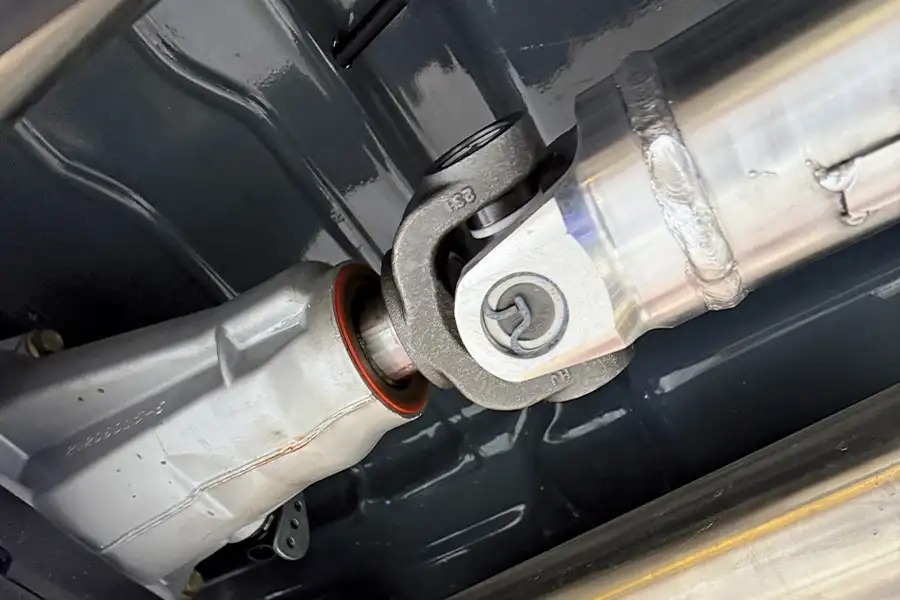
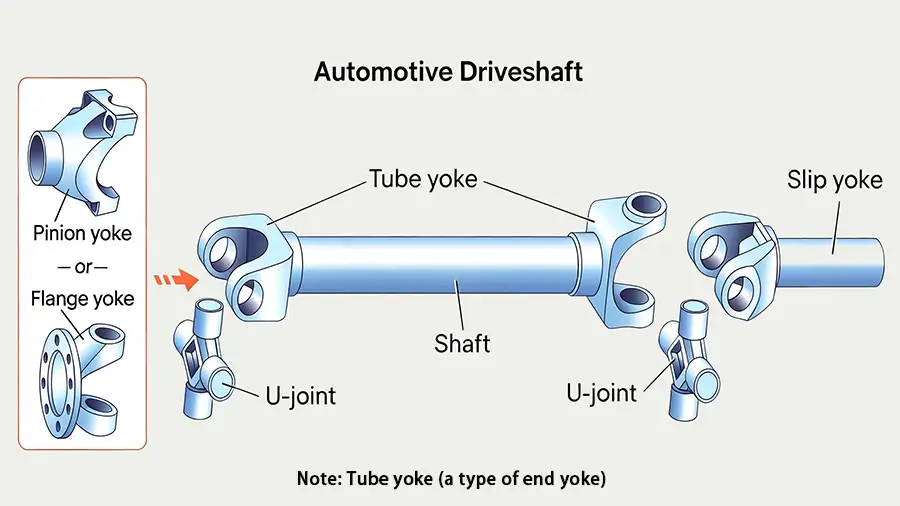
An end yoke is generally installed at the end of a driveshaft and works with a universal joint. The U-joint sits inside the yoke, allowing the driveshaft to transmit power even when there is an angle between connected components.
End yokes are found on a wide range of passenger vehicles, trucks, and heavy-duty driveline systems. They can be used on different sections of a driveshaft depending on the vehicle design.
One thing that often causes trouble during replacement is assuming that two similar-looking yokes will fit the same U-joint. They may have different bearing cap sizes, overall widths, snap-ring arrangements, spline dimensions, or mounting measurements.
So, when replacing an end yoke, appearance alone is not enough. The dimensions of the original part should always be checked.
Slip Yoke: Designed to Move
A slip yoke has a job that sets it apart from the other two.
Instead of making a completely fixed connection, a slip yoke allows the driveshaft to move in and out slightly. This movement is necessary because the distance between the transmission and rear axle can change as the suspension moves.
Slip yokes are commonly used on the transmission side of traditional driveshaft systems. As the yoke slides along the splines of the transmission output shaft, the driveshaft continues to spin. That small amount of movement may not seem like much, but it helps prevent the driveline from binding as the vehicle moves.
If the slip yoke or another component wears, drivers may hear a clunk when going from Park to Drive or Park to Reverse. Vibrations or fluid leaks from the area of the transmission tailshaft could both indicate a problem requiring attention.
For replacement, spline count and diameter are particularly important. A slip yoke can look almost identical to another one while having completely different spline dimensions.
Flange Yoke: A More Rigid Connection
The flange yoke takes a different approach. Rather than sliding onto a transmission output shaft, it uses a flange-style mounting connection, usually secured with bolts.
This type of yoke is commonly used where a driveshaft needs to connect to a differential, transfer case, transmission, or another flange-mounted driveline component.
The benefit is a firm and stable connection. There is no need for the yoke to provide the same sliding movement as a slip yoke.
Of course, flange yokes come with their own fitment details. Bolt pattern, flange diameter, pilot diameter, spline specifications, and U-joint dimensions can all vary.
This is one reason a replacement part should never be selected just because the flange “looks right.” A small difference in bolt spacing or pilot diameter can be enough to make installation impossible.
So, What Is the Difference?
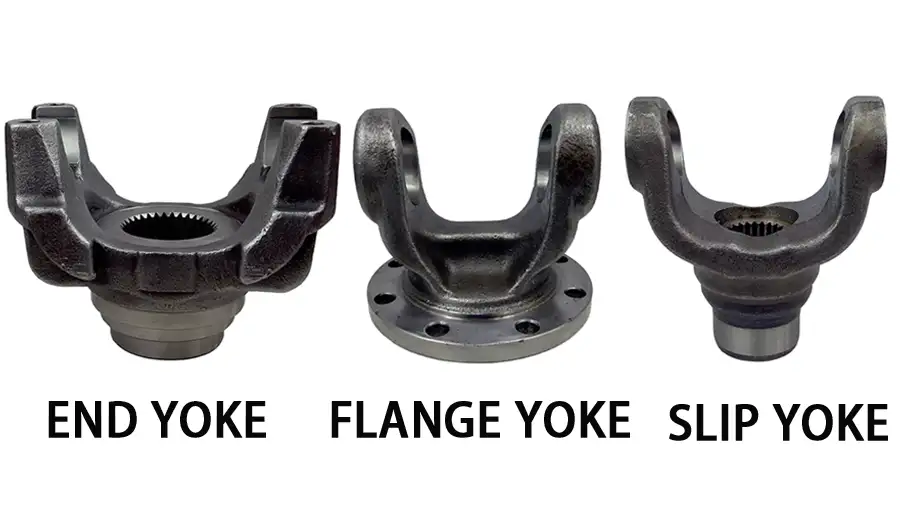
At this point, the basic distinction is fairly simple. An end yoke is primarily there to work with a universal joint, a slip yoke allows the driveshaft to accommodate changes in length, and a flange yoke provides a rigid bolted connection.
| Yoke Type | Main Purpose | Typical Connection | Main Characteristic |
|---|---|---|---|
| End Yoke | Connects the driveshaft to a U-joint | Universal joint | Transfers torque through the U-joint |
| Slip Yoke | Allows driveline length changes | Transmission output shaft | Slides on splines during operation |
| Flange Yoke | Creates a fixed driveline connection | Flange or companion flange | Bolted, rigid connectio |
A worn slip yoke, however, can cause problems. Excessive wear around the splines or sealing surface may contribute to vibration, looseness, or fluid leakage at the transmission tail housing.
Choosing the Right Driveshaft Yoke
For replacement work, the vehicle make and model are just the beginning. The transmission, differential, driveshaft design, U-joint size, spline count, and even the original part number can all make a difference when it comes to fitment. This is especially true for older vehicles, modified drivetrains, different versions of the same vehicle. Two vehicles with the same engine may sometimes have different driveline components.
A good rule is always to compare the replacement yoke with the original part before installing. Compare key dimensions, spline configuration, U-joint size and mounting pattern, not simply by appearance. The yoke may not be the biggest part in the driveshaft assembly, but it’s one of the parts that helps keep everything connected and moving properly.Once you get a grasp of what each type is designed to do, choosing replacement parts becomes quite simple.