
Balanced vs. Unbalanced Driveshafts: Key Insights
A driveshaft is easy to ignore because it lives under the vehicle and (when it’s healthy) does its job quietly. But when a vehicle develops a steady, speed-related tremor—often most obvious on the highway—the driveshaft moves from “out of sight” to “can’t un-feel.” The difference between balanced driveshafts and an unbalanced assembly isn’t just comfort; it’s load, heat, and fatigue being fed into parts that were never meant to absorb it.
What “balance” really means in a rotating driveline
Balance is not an aesthetic concept; it’s a rotating-mass problem. Any offset mass (even small) produces a centrifugal force that rises with rpm. That’s why a driveshaft that feels “fine” at 35 mph can become unpleasant—or destructive—at 65–75 mph. In practice, balance depends on multiple things happening at once: straightness (runout), correct joint angles, correct phasing, intact weights, and components that were assembled in the orientation the driveline shop intended.

How a driveshaft becomes unbalanced (common, unglamorous reasons)
Most imbalance stories aren’t mysterious. They’re the result of ordinary life under a vehicle:
Lost or damaged balance weights from corrosion, road debris, or an off-road hit.
Assembly changes after a U-joint replacement or slip-yoke service (parts can go back together “one spline off,” or the shaft can be clocked differently).
Bent tube from an impact or improper lifting/strapping.
Compounding issues: a borderline driveline angle plus minor imbalance can feel like a major failure.
Symptoms that point to imbalance (and what they’re not)
Drivers usually describe imbalance as a constant, rhythmic vibration that tracks vehicle speed more than engine rpm. Two practical comparisons help during diagnosis:
U-joint wear often adds a clunk on takeoff or on shifting from reverse to drive; imbalance is more “steady buzz” than “single knock.”
Center support bearing issues (two-piece shafts) can introduce a growl/whine and then a shudder under load; imbalance tends to feel like the entire floorpan is being excited at one frequency.
Why ignoring it gets expensive fast
An unbalanced shaft doesn’t just “shake.” It repeatedly loads transmission output bearings, tailshaft seals, pinion bearings, mounts, and even exhaust hangers. Over time, those cyclic forces can widen clearances and turn a small vibration into a cascade of noise, leakage, and driveline lash. In extreme cases, the safety risk isn’t theoretical: a failing driveline component can damage the underbody or drop the shaft.
The real fix: driveshaft balancing (and why DIY is rarely satisfying)
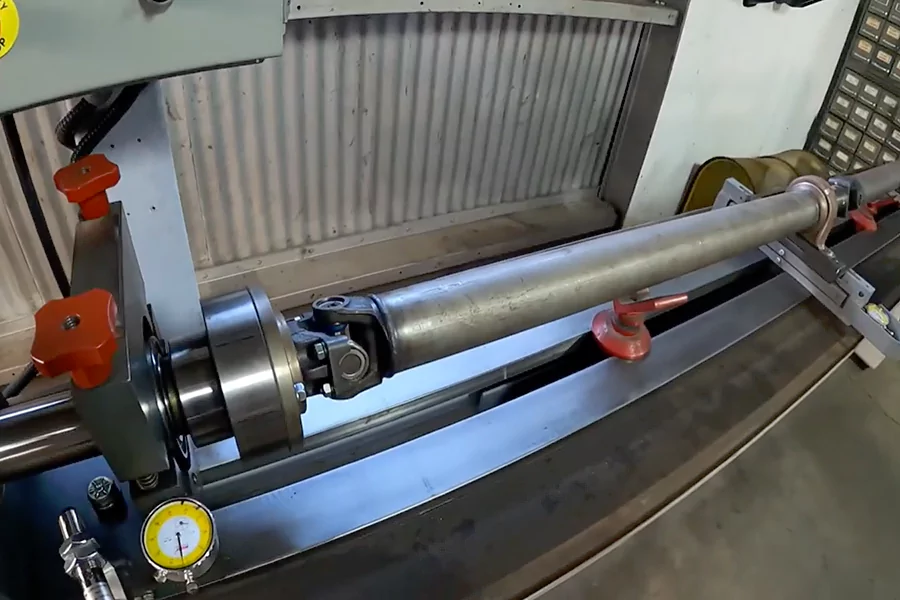
People try hose clamps because it’s tempting to treat imbalance like tire balancing. The problem is that a driveshaft is long, spins fast, and can be sensitive to both where and how weight is applied. Professional driveshaft balancing typically includes checking runout, verifying phasing, inspecting yokes, and then performing dynamic balancing at controlled speed. That process also forces an honest look at the basics of driveshaft maintenance: joint condition, slip-yoke lubrication, and whether the shaft is straight enough to be worth balancing.
If a vibration appears after driveline work, an impact, or months of corrosion exposure, treat the driveshaft as a prime suspect. Restoring balance is less about chasing a “perfect feel” and more about keeping the rest of the drivetrain out of the vibration business.