
Steel, Aluminum, Carbon Fiber — Driveshaft Material Isn’t Just About Weight
Most material comparisons start the same way: steel is strong, aluminum is lighter, carbon fiber is premium. That’s technically correct. It’s also incomplete.
A driveshaft doesn’t fail because of a bullet-point spec sheet. It fails because of how it’s used. Long highway cruising at steady RPM is one thing. Hard launches, traction changes, driveline misalignment — those are different stories.
Material choice starts to matter when conditions aren’t ideal.
Steel: Why It’s Still Everywhere
There’s a reason steel driveshafts are still standard in trucks, industrial equipment, and a large percentage of production vehicles. They behave predictably.
Under torsional load, steel stretches slightly and distributes stress in a way that’s well understood. If something in the system isn’t perfect — slight imbalance, imperfect alignment, occasional shock load — steel usually tolerates it.
It’s heavier, yes. That extra rotating mass increases inertia. In performance applications, that can dull throttle response slightly. In commercial vehicles, nobody notices.
Where steel becomes a limitation is in long shafts spinning at higher RPM. Critical speed drops as length increases. To compensate, you increase tube diameter. Sometimes that works. Sometimes packaging space doesn’t allow it. But for durability and cost control, steel remains difficult to beat.
Aluminum: A Noticeable Change, Not a Radical One
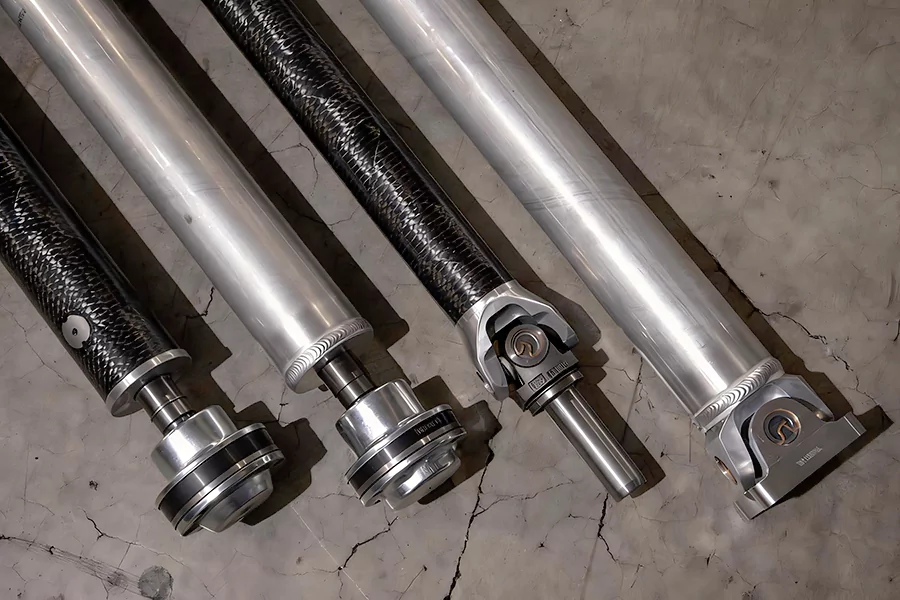
Switching to an aluminum driveshaft is often the first step when someone wants improvement without redesigning the entire driveline. The reduction in rotating mass is real. In lighter performance vehicles, it can be felt in responsiveness. It’s not dramatic in every platform, but it’s there.
Because aluminum tubes are typically built with larger diameters to maintain stiffness, critical speed often improves compared to steel in the same length. That’s helpful in higher RPM street builds.
What aluminum doesn’t love is repeated shock. Sudden torque spikes — aggressive clutch engagement, traction break and regain — can stress it differently than steel. It doesn’t have the same forgiveness.
For controlled environments, aluminum works well. For unpredictable load conditions, some engineers still hesitate.
Carbon Fiber: Different Behavior Entirely
Carbon fiber driveshafts don’t just reduce weight — they change how vibration travels.
Composites damp differently than metals. At high rotational speeds, that can translate into less resonance through the chassis. In certain applications, that alone justifies the material shift.
Critical speed increases significantly in long-span applications. Lower density combined with directional stiffness makes a difference when RPM climbs.
But carbon fiber only performs as intended if it’s engineered correctly. Fiber orientation, bonding at the yoke interface, curing consistency — those details decide whether it behaves like a premium solution or an expensive mistake.
It’s also less forgiving in impact scenarios. Steel bends. Composite reacts differently.
That doesn’t make it fragile. It just means the failure mode isn’t the same.
What Actually Drives the Decision
Most of the time, the choice isn’t philosophical. It comes down to a few practical questions:
How long is the shaft?
What’s the maximum sustained RPM?
Will the vehicle see shock loading?
Is NVH a concern?
Is budget flexible or fixed?
Two builds with similar horsepower numbers can end up with different driveshaft materials because the duty cycle isn’t the same.
A work truck that tows weekly and occasionally sees uneven terrain may stay with steel.
A street performance car chasing quicker response may move to aluminum.
A high-RPM track build concerned about vibration stability may justify carbon fiber.
There isn’t a universal winner.
On Paper vs. In Use
Spec sheets compare weight, torque rating, and cost. Real-world operation adds fatigue cycles, heat, imbalance, installation quality, and driving behavior.
Driveshaft materials influence all of it, but rarely in isolation.
That’s why the best material is usually the one that matches how the vehicle actually lives — not how it looks on a comparison chart.
About HZSP
HZSP produces custom driveshaft assemblies for automotive and industrial applications. Steel, aluminum, and carbon fiber configurations are selected based on operating speed, torque demand, shaft length, and service conditions.
Rather than defaulting to a single material, the focus is on matching driveshaft construction to how the system will actually be used.