
Custom Driveshaft Orders: Lead Times, Drawings and Tolerances
This blog is written for engineers, purchasing managers, and workshop owners, with the goal of creating clearer communication between both sides and facilitating smooth and successful business cooperation.
1) Lead times — what affects them (and realistic ranges)
Factors that move the calendar: material sourcing (steel, stainless, titanium, carbon fiber), required heat treatment, custom splines/yokes, need for precision CNC grinding and high-speed balancing, availability of tooling, and whether a bespoke layup (for carbon) is required. Many established custom suppliers publish lead times that fluctuate by season and order backlog; for example, some shops quote ~2 weeks for standard custom builds while others (or specialty carbon/competition builds) routinely take 3–4+ weeks. Plan for deposits and for ±a few business days of scheduling variance.
But considering factors such as transportation and vessel schedules, the actual lead time may extend to 1–2 months or even longer. However, at HZSP, we will make every effort to meet our customers’ delivery requirements.
Rule of thumb for procurement
Rapid/stock-style custom: 1–5 business days (if using common components or in-stock assemblies).
Standard custom: ~1–2 weeks (most common builds).
Complex / high-performance / carbon: 3–6 weeks (can extend for special materials or testing).
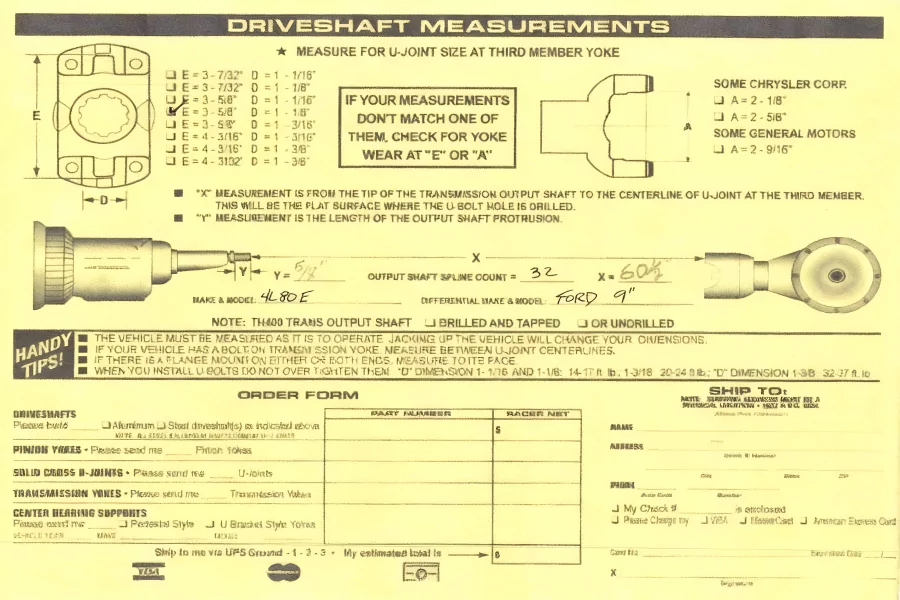
2) Drawings & key specifications to include with a Custom Driveshaft order
A clear, unambiguous package prevents rework and saves lead time:
Minimum required deliverables
- 3D model (STEP/IGS preferred) + one 2D drawing with GD&T callouts.
- Exact center-to-center length: measure on the vehicle with the suspension loaded to the operating condition you want the shaft set for (race/ride height). Include slip allowance for slip-yokes.
- U-joint series & cup diameter, or mating flange dimensions (series numbers such as 1310/1330/1350 are common references).
- Spline count / profile, tube O.D. & wall thickness, tube material spec, yoke type (weld, slip, flange), and torque/HP expectations.
- Notes on surface finish, heat treatment, keyways, grease fittings, and any safety/inspection standards required.
Why 3D helps: many manufacturers — especially for carbon or precision-machined steel shafts — model the whole assembly to calculate critical speed, wall thickness, and balancing locations before production.
3) Tolerances, runout & balancing — what to specify
Tolerances (practical guidance)
For many precision driveshafts, diameter and fit tolerances are tight. If you specify ±0.0002 in (≈ ±0.00508 mm) that is industry-grade precision for diameter-critical fits; conversely, ±0.005 mm equals ≈ ±0.000197 in — be consistent with units in drawings. (Conversion: 0.0002 in × 25.4 = 0.00508 mm.) Always show both units if your vendor/inspection house may prefer one.
Runout / concentricity
Use GD&T callouts: Total runout or cylindricity on critical journals and concentricity/coaxiality between bearing surfaces and the tube OD are typical. Industry guidance treats runout as the controllable “wobble” metric for rotating parts; acceptable runout depends on RPM and application but controlling it at the 0.001–0.010 in range (application dependent) is common practice — race/high-speed shafts require tighter control and often CNC grinding to meet those figures.
Balancing
High-speed balancing is essential for high RPM and high-power applications. Unbalanced shafts produce NVH, premature U-joint and bearing wear, and safety risks. Specify the maximum residual imbalance (e.g., ounce-inches) or request the supplier’s high-speed balancing certification. Suppliers commonly balance shafts at speeds corresponding to typical operating ranges and may offer certificates of balance.
Operating angles
Where u-joint life is a concern, aim for operating angles ≤ 3° if possible — higher angles increase cyclic load on U-joints and shorten service life. (If your application forces larger angles, discuss constant-velocity solutions or dogbone arrangements.)
4) Materials — selection guidance
Standard / economical: mild steel or chromoly (e.g., 42CrMo for higher strength after heat treatment). 42CrMo (≈ 0.42% C, Cr/Mo alloy) is widely used where high fatigue strength and hardenability are needed.
Corrosion resistance: 304/316L stainless where environment is aggressive.
High-performance: carbon fiber (for low rotational mass and high critical speed) or titanium when both strength and lightness are required (costly). For carbon shafts, suppliers model critical speed and publish lead times specific to bespoke layups.
5) Ordering process, payment and QA checkpoints
Typical commercial flow
RFQ with CAD/drawings and performance brief.
Quote (lead time, tooling, MOQ if any).
Deposit: many vendors require a non-refundable deposit (commonly 50%) before production tooling or cutting begins. Confirm refund policy.
Pre-production approval: vendor sends a manufacturing drawing or sample for sign-off.
Production → Inspection → Balancing → Test report (request the balancing certificate and runout/concentricity measurements).
Quality checklist to request before shipment
As-produced dimensional report (critical datums).
Runout and concentricity readings.
Balance certificate (speed and residual imbalance value).
Material certificates (heat treatment / metallurgy for alloys).
Photographs of critical welds and weld procedures if tube/yoke welding is involved.
6) How to write a concise RFQ for a Custom Driveshaft
Include these fields so suppliers can price and schedule fast:
- Part name / rev, target qty, and delivery location.
- 3D model (STEP) + 2D drawing with GD&T.
- Exact center-to-center length (state vehicle loaded condition used).
- U-joint series (or flange spec), spline count/profile, and mating dimensions.
- Material spec and heat treat requirements.
- Expected max torque/HP and maximum operating RPM.
- Inspection requirements: runout limit, balance residual spec, material certs.
- Requested lead time and whether 50% deposit is acceptable.
7) About HZSP
HZSP (Auto-Driveshaft.com) is a technical supplier of custom driveshaft assemblies for industrial, agricultural and performance applications. We accept 3D CAD (STEP/IGS) and detailed 2D drawings, perform GD&T-based inspections, and provide high-speed balancing and material certificates on request. Contact HZSP with your RFQ and CAD package for a tailored quote and lead-time estimate.