
What Causes Driveshaft Failure? The Role of Shock Loads
A driveshaft handles a lot of torque. What kills it is torque that shows up all at once.
That sudden hit is a shock load. It’s why a driveshaft or U-joint can break even when the shaft looks strong enough on paper. The machine runs fine for months, then one hard clutch drop, a wheel that hops and grabs, a sudden traction change, or an overload, and a sharp torque spike goes straight through the driveline.
What comes back is a twisted shaft, a cracked U-joint, a torn yoke, or a bearing that let go.
What a shock load actually is
A shock load is when the torque changes in a split second instead of ramping up gradually.
Picture a truck climbing a hill. Torque flows through the transmission, driveshaft, diff, and axles in a controlled way. Then a wheel breaks loose and grabs again, or the truck hits something while the power’s on. The driveline sees a spike way past what it was built for.
Farm equipment, PTO-driven machinery, off-road rigs, and work trucks live in this world. Their loads change constantly and the driveline takes sudden resistance all day.
Why shock loads tear a shaft apart
A driveshaft is built for a torque range. A shock load blows past that range because the peak is far higher than the normal working load.
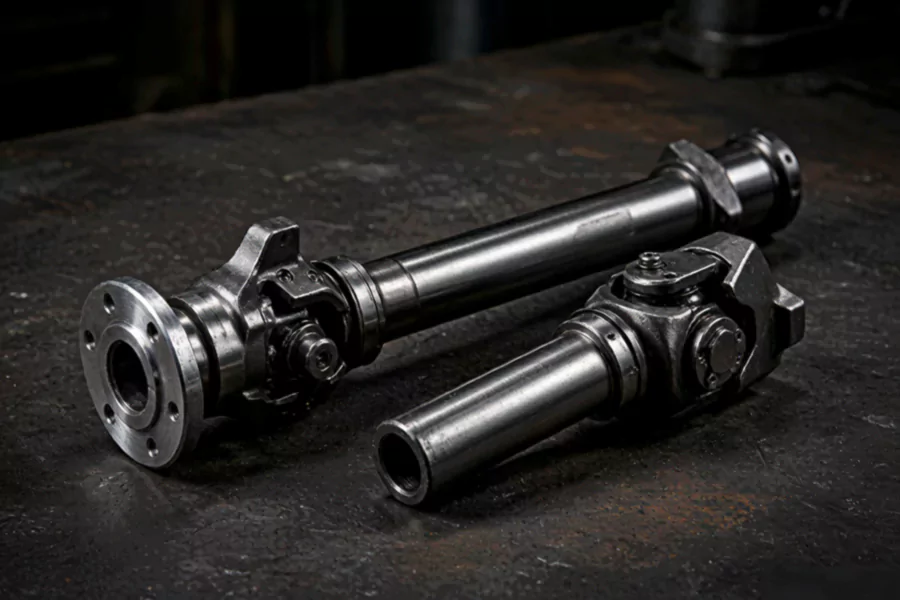
The parts that go first are the ones that connect and flex:
- U-joints
- Yokes
- Splines
- Flanges
- Center support bearings
- The tube itself
A U-joint will run a long time under a high but steady load. A spike is different. It puts an instant stress concentration through the cross, the bearing cups, and the yokes.
Repeated spikes are worse. One event might not show damage, but the fatigue adds up. Hairline cracks and permanent deformation turn into a full break over time.
Shock loads rarely work alone
Blaming every driveshaft failure on too much torque misses the point. Most of the time, the shock just exposes a weakness that was already there.
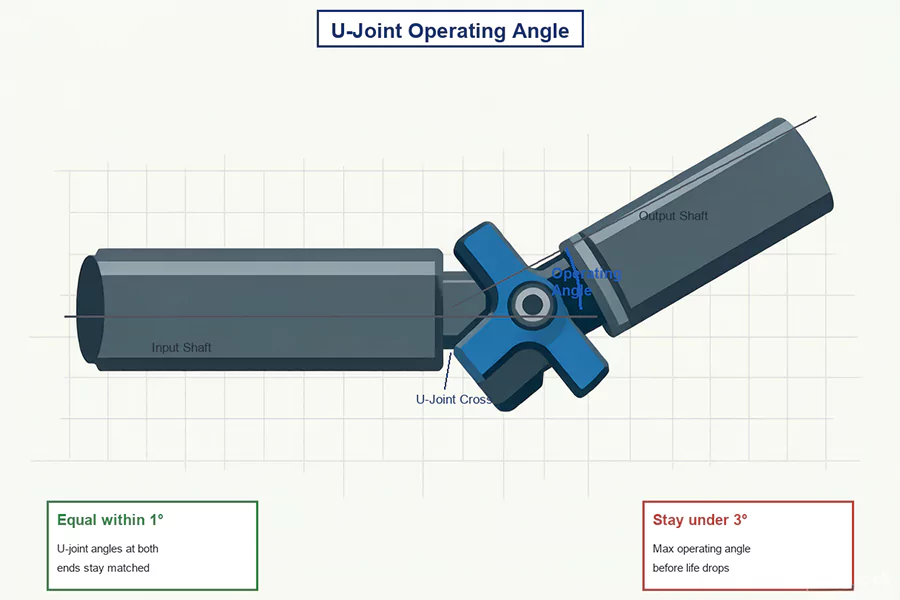
A bad operating angle is a classic. Keep the U-joint angles within 1° of each other and stay under 3° total. Go past that and you add vibration and eat U-joint life.
A shaft that’s already running bad angles, worn joints, out of phase, or out of balance has almost no margin left. Add a shock load and it fails right then, even though it looked fine the day before.
Worn U-joints make it worse
When a driveshaft fails, the U-joint is the first place to look.
Wear opens up clearance between the bearing cups, trunnions, and yokes. Once that slop gets big enough, the joint stops transferring torque cleanly.
A worn U-joint that’s already loose, plus a sudden torque spike, is a bad combination. The shock doesn’t hit a healthy joint. It hits one that already has play and less fatigue life.
Angle and speed matter just as much
Shock loads aren’t the only thing that kills a driveshaft. Speed and angle do too, and they stack.
The safe operating angle drops as RPM rises. At high shaft speed, even a small angle makes real vibration and shortens part life. The shaft also has a safe speed set by tube diameter, length, joint setup, and how it’s built. Run past it and the thing can shake itself apart.
So a stronger heavy-duty driveshaft isn’t always the fix. The whole driveline has to be sized, angled, and balanced for the job.
How to cut shock-load failures
You can’t remove every shock load. Heavy equipment hits sudden resistance, that’s the job. The goal is to cut the avoidable impacts and make sure the driveline has the capacity to survive the rest.
- Size the shaft for peak torque, not average. A shock load is the peak.
- Check the U-joints regularly. Loose caps, worn trunnions, missing retainers, dry bearings.
- Check the angles. If you changed ride height, moved the axle, or swapped the trans, recheck the U-joint angles.
- Check balance and runout. An out-of-balance shaft vibrates and wears everything faster.
- Look at what’s around it. A bad yoke, worn spline, loose flange, or dead center bearing turns normal torque into a problem.
Picking the right replacement
When a driveshaft fails, swapping the one visibly broken part isn’t always enough. Find out why it broke first.
Overloaded? Shock load? Seized U-joint? Out of balance? Bad angles? Was the spline or yoke already worn?
Then match the replacement driveshaft assembly to the machine’s torque, RPM, dimensions, U-joint series, spline, operating angle, and how it mounts.
For custom builds, accurate dimensions and drawings matter more than anything. A proper spec has center-to-center length, U-joint series, spline profile, tube diameter and wall thickness, material, expected torque, horsepower, and max operating RPM. Miss one and the new shaft fails the same way the old one did.
HZSP: driveshafts built to the spec, not to the guess
For buyers looking for automotive driveshafts, U-joints, or custom driveline parts, HZSP supplies automotive, agricultural, industrial, and performance applications.
Hangzhou Speedway (HZSP) has been in the driveshaft business more than 25 years. The range covers complete driveshaft assemblies, U-joints, yokes, flanges, splined parts, center support bearings, and the related driveline components. They take custom projects off customer drawings and specs, work from 3D CAD and 2D drawings, and run GD&T-based inspection and high-speed balancing.
A driveshaft usually doesn’t fail because one number was a little off. It fails when shock loads, torque, speed, angle, wear, and installation all line up wrong at once. Understand how those stack up and you’ll pick a replacement that lasts longer than the last one.