
Fixed Yoke vs Slip Yoke: What’s the Difference?
Have you ever wondered how a vehicle efficiently transfers power from the transmission to the rear wheels while still absorbing bumps and suspension movement? This function is handled by the drivetrain system, with the driveshaft and its connection components playing a critical role.
If you are upgrading a drivetrain, lifting a 4×4 truck, or diagnosing a clunking noise under the vehicle, one common question arises: Fixed Yoke vs Slip Yoke—what’s the difference?
Understanding these components is essential for maintaining safe, smooth, and reliable driveline performance.
The Basics of Rear-Wheel-Drive Drivetrain Systems
To understand the difference between fixed yoke and slip yoke systems, it is important to first understand the drivetrain layout.
In a typical rear-wheel-drive vehicle, power flows as:
Engine → Transmission → Driveshaft → Rear Differential
Because the rear axle moves up and down with suspension travel, the distance between the transmission and differential constantly changes. Therefore, the driveshaft must accommodate this length variation to avoid binding, excessive stress, or component failure.
What Is a Slip Yoke and How Does It Work?
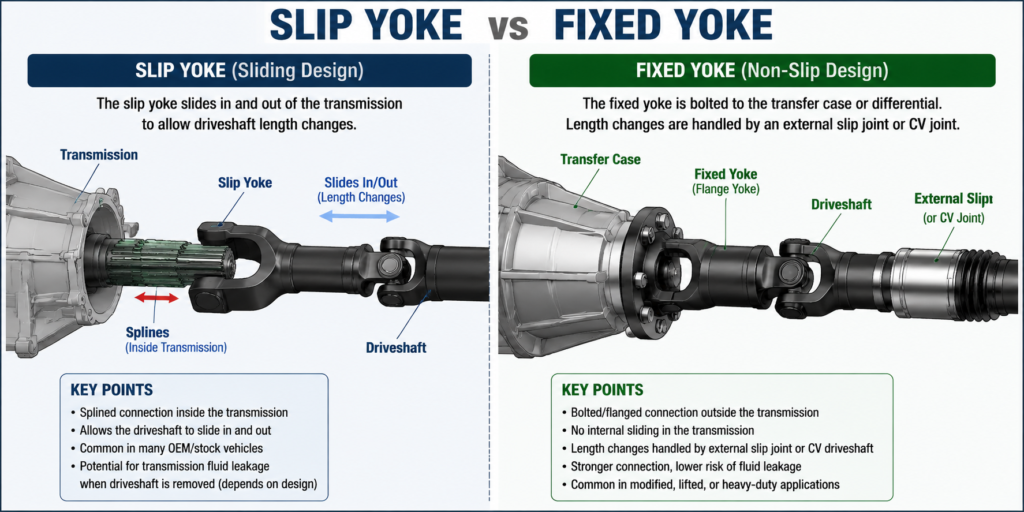
A slip yoke is a splined component that engages with the transmission or transfer case output shaft and allows axial movement.
Its internal splines slide in and out during suspension travel, allowing the driveshaft to adjust length dynamically while maintaining torque transfer.
Common Slip Yoke Designs
Internal Slip Yoke (Transmission-Style)
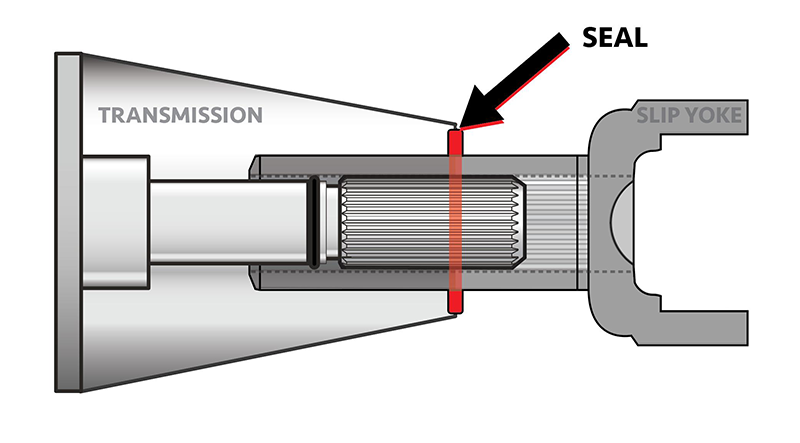
The slip yoke is inserted directly into the transmission or transfer case tail housing and is lubricated by transmission fluid. This design is commonly used in many OEM passenger vehicles.
External Slip Joint
In this configuration, the slip mechanism is integrated into the driveshaft itself rather than the transmission. Both ends of the driveshaft use fixed connections, and length compensation occurs within the shaft assembly.
What Is a Fixed Yoke?
A fixed yoke refers to a driveline configuration where the output connection does not rely on an internal sliding slip yoke at the transmission or transfer case.
Instead, the driveshaft connects via a flange or yoke assembly that is bolted to the output flange of the transmission, transfer case, or differential.
For example, a pinion yoke at the rear differential is a common fixed connection point. Many modern vehicles use a flange-style driveline where the driveshaft bolts directly to a companion flange.
In fixed yoke systems, driveline length compensation is handled by an external slip joint or a constant velocity (CV) driveshaft design.
Fixed Yoke vs Slip Yoke: Advantages and Disadvantages
Slip Yoke Advantages
- Simple and cost-effective design used in many OEM applications
- Smooth telescoping movement under normal driving conditions
- Compact integration with the transmission or transfer case
Slip Yoke Disadvantages
- Reduced spline engagement in lifted or modified suspension setups
- Potential for tail housing wear over time
- Possible fluid leakage when the driveshaft is removed (depending on design)
Fixed Yoke Advantages
- Stronger flange-based connection suitable for high torque applications
- Reduced risk of transmission or transfer case seal disturbance during servicing
- Better suited for lifted, off-road, or heavy-duty driveline setups
Fixed Yoke Disadvantages
- Requires an external slip joint or CV driveshaft for length compensation
- More complex and often more expensive driveline configuration
- Typically used in performance or heavy-duty applications rather than basic OEM setups
Common Symptoms of Driveline Issues
Driveline components operate under high stress and wear over time.
A clunking noise during acceleration or deceleration may indicate slip yoke binding or worn splines.
High-speed vibration felt through the vehicle is often caused by worn U-joints, imbalance in the driveshaft, or damaged yoke components.
Transmission fluid near the tail housing may indicate a worn output seal or excessive movement caused by internal bushing wear.
Upgrades and Maintenance Considerations
Vehicles with increased ride height or suspension modifications may exceed the operating range of a factory slip yoke system.
A Slip Yoke Eliminator (SYE) kit replaces the factory slip yoke output with a fixed yoke configuration. This allows the use of a longer driveshaft, typically paired with a double-cardan (CV) shaft, improving driveline angles and reducing vibration.
When servicing driveline components, U-joints may be either greasable or non-greasable:
- Greasable U-joints allow easier maintenance in contaminated environments
- Non-greasable U-joints are often more durable due to a fully sealed design
Driveshaft Installation and Measurement Notes
Proper measurement and installation are critical for driveline reliability.
Driveshaft length should always be measured at normal ride height with the vehicle under load.
Incorrect sizing can lead to:
- Bottoming out, which may damage the transmission or transfer case
- Excessive extension, increasing the risk of driveshaft separation during suspension droop
Final Verdict
Slip yoke systems are widely used in OEM passenger vehicles due to their simplicity, compact design, and smooth operation.
Fixed yoke systems, on the other hand, are commonly used in lifted, off-road, and heavy-duty applications where increased durability, serviceability, and driveline strength are required.
Selecting the correct configuration depends on vehicle usage, suspension design, and drivetrain requirements. Proper setup and maintenance ensure stable power delivery and long-term reliability.