
Driveshaft Safety Standards and Testing Methods You Should Know
If you’ve worked with driveline systems long enough, you’ll notice one pattern: driveshafts almost never fail suddenly without any signs. There is usually something off beforehand—slight vibration, a bit of noise, maybe a loose feeling when rotating by hand. The problem is, these early signals are often ignored.
That’s essentially where driveshaft standards come in. They’re not just written for compliance—they exist because these small issues, if left unchecked, tend to turn into real failures.
It’s Not Just About Strength
A common misunderstanding is that a driveshaft only needs to be “strong enough.” In reality, strength is only one part of the equation.
A shaft can pass torque requirements and still fail in service.
Why? Because most failures are not caused by overload, but by a combination of smaller factors—misalignment, imbalance, wear, or even improper installation.
That’s why most driveshaft standard requirements look surprisingly basic:
- No noticeable play in U-joints
- No dents or deformation on the tube
- Proper alignment during operation
- Guards in place for exposed rotating shafts
None of these sound complex, but every single one is tied to a real failure case.
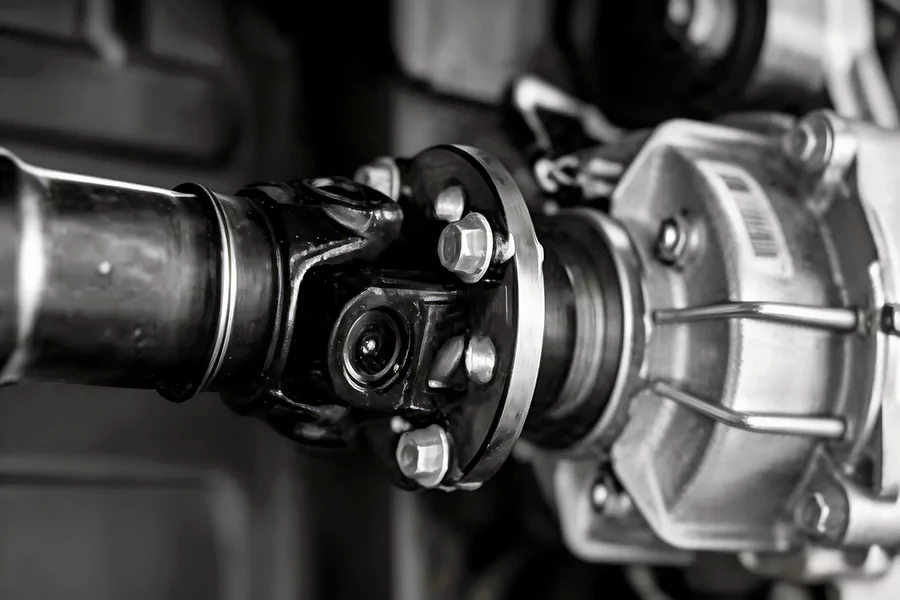
Testing: Closer to Reality Than It Looks
When people hear “testing,” they often think of extreme lab conditions. But in driveshaft testing, the goal is actually the opposite—replicating real use as closely as possible.
Torsion testing is the most straightforward one. You apply torque, sometimes repeatedly, and see how the shaft behaves. Does it deform? Does it hold? That gives you a baseline.
But that’s not what usually breaks a shaft.
Fatigue is.
A shaft running under normal load, day after day, will eventually develop stress concentrations—especially around splines or welds. Over time, tiny cracks form, grow, and then one day, the shaft fails.
That’s why endurance testing matters more than peak-load testing in many cases.
Then there’s balancing, which is often underestimated.
A slight imbalance may not show up at low speed, but once RPM increases, things change quickly. Vibration builds up, bearings take extra load, joints wear faster—and the entire system starts degrading.
Where Things Actually Go Wrong
If you look at failed driveshafts in the field, most of them don’t fail because they were poorly designed.
They fail because something small was missed.
Lubrication is a typical example. It sounds basic, but it’s one of the most common causes of failure. Without proper grease, internal components wear much faster than expected.
Bolt torque is another one. A slightly loose flange bolt may not seem urgent, but under continuous operation, it can loosen further—and in worst cases, lead to separation.
Then there are the visual signs that are easy to overlook:
- Light rust around joints
- Small dents on the tube
- Debris wrapped around the shaft
- Contact marks from nearby components
Individually, these don’t always look serious. Together, they tell a different story.
Failure Doesn’t Happen Randomly
Most driveshaft failures follow a pattern.
Fatigue cracks are probably the most common. They usually start at a weak point—often somewhere with stress concentration—and grow over time.
Wear is another. Splines, bearings, and joints gradually lose precision, which then introduces vibration.
And once vibration starts, it tends to make everything worse.
That’s the part people often underestimate: these issues are connected. One problem rarely stays isolated.
Design Limits Still Matter
Even if everything is manufactured correctly, the way a driveshaft is used still plays a huge role.
Operating angles, for example, are often overlooked during installation. If the angles are not properly matched, the joints experience uneven loading.
Length is another factor. Longer shafts are more sensitive to vibration, especially at higher speeds.
And then there’s rotational speed itself. Every shaft has a limit. Exceed it, and even a perfectly balanced shaft can become unstable.
Final Thoughts
At the end of the day, driveshaft safety isn’t controlled by a single factor.
It’s a combination of design, testing, installation, and maintenance.
Most failures don’t come from something dramatic—they come from small issues that were either missed or ignored.
Understanding driveshaft standards helps, but applying them in real conditions is what actually makes the difference.
At HZSP, we focus on that practical side. Whether it’s PTO shafts or driveline components, the goal is not just to meet specifications, but to make sure the product performs reliably once it’s in use—where conditions are rarely perfect.