
Agricultural vs Automotive Driveshafts Explained
What Makes Agricultural Driveshafts Different
Agricultural driveshafts, often seen as PTO shafts, transmit engine power from tractors to implements like mowers, balers, seeders, and tillers. Unlike automotive driveshafts, agricultural shafts prioritize flexibility, field adjustability, high torque capacity, and exposed safety features. These design priorities influence materials, geometry, testing, and user instructions.
Primary Function – Power Transfer to Implements
Automotive driveshafts transmit relatively steady torque to wheels, while agricultural PTO shafts deliver intermittent high torque to implements. They must handle start-stop loading, clutch engagement, and torque spikes, requiring stronger design margins and protective measures.
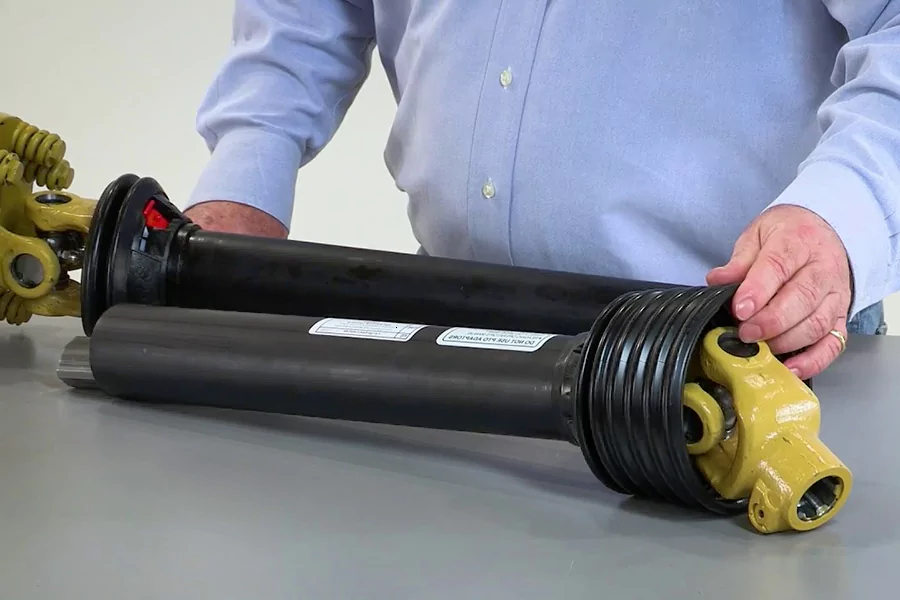
Flexibility & Variable Geometry
Telescopic Spline Assemblies
Telescopic splined tubes allow the driveline to adjust length while transmitting torque. This is essential when implements are raised, lowered, or towed over uneven terrain.
Universal & CV Joints
Universal (Cardan) joints and CV PTO joints accommodate angle changes between tractor and implement. This flexibility ensures smooth power delivery under varying positions.
Durability for Shock Loads & Contamination
Agricultural driveshafts face shock loads from rotor stalls, stone impacts, or roots. They are built with robust materials, larger cross-sections, and conservative fatigue margins. Finite-element analysis confirms that shock, impact, and misalignment are common causes of PTO failures.
Safety Features
Exposed PTO shafts rotate at high speed, so protective guards and master shields are essential. Proper installation, inspection, and operator training reduce entanglement risks.
Modularity & Connector Standards
Agricultural driveshafts are modular for frequent field connection/disconnection. Standardized splines and pin-lock or spring-lok connectors allow easy repairs and length adjustments, improving uptime and simplifying inventory for dealers.
Serviceability & Maintenance
Because agricultural shafts operate in muddy, abrasive environments, serviceability is critical. Grease fittings, replaceable cross & bearing kits (U-joint kits), and easily replaceable guards are standard. Suppliers typically supply maintenance schedules and recommended grease types; following these instructions dramatically extends component life and supports warranty enforcement. Regular inspection for play, worn splines, shield integrity, and u-joint play should be listed on operator checklists.
Secondary Drivelines in Implements
Some implements include internal drivelines. These face similar challenges—shock resistance, sealing, fatigue life—but are enclosed and follow different safety rules than external PTO shafts.
Quick Comparison: Agricultural vs Automotive Driveshafts
| Feature | Agricultural Driveshaft | Automotive Driveshaft |
|---|---|---|
| Purpose | Tractor → implement | Vehicle → wheels |
| Geometry | Telescoping + wide-angle joints | Mostly fixed length, small angles |
| Loads | Intermittent high torque & shocks | Steady torque cycles |
| Safety | Exposed parts require guards | Mostly enclosed |
| Service | Field service & modular repair | Workshop-level replacement |
Choosing the Right Agricultural Driveshaft
- Match spline count and connector style to tractor and implement.
- Choose telescoping length range with margin for raised/lowered positions.
- Specify U-joint type (standard vs wide-angle or CV PTO) for required angle.
- Confirm shield/guard details and anchoring provision.
- Validate materials and welding/NDT records if the shaft will see shock or heavy-duty service.
- Confirm spare parts availability (crosses, guards, yokes) for field repairs.
About HZSP
Driveshafts for agricultural machinery differ from automotive ones in design and durability requirements. They must handle higher torque, uneven terrain, and continuous operation. HZSP leverages BAIQUAN’s expertise in agricultural drivetrains to produce robust PTO shafts and related components, including telescopic spline assemblies, universal joints, and CV joint configurations. We also provide dynamic balancing, protective covers, and material traceability. Our solutions ensure safety, reliability, and long service life for modern farming equipment.