
Slip Yoke vs Flange Yoke: Which One Should You Use?
A slip yoke is a splined part that lets the driveshaft change length. It fits into the transmission or transfer case output. When the suspension moves, the slip yoke slides in and out. That sliding keeps U-joint angles within a safe range. Many factory rear-drive systems use a slip yoke.
A flange yoke bolts to a matching flange on the transmission, transfer case, or differential. It is a fixed connection and does not slide. Any length change must be handled by the driveshaft itself. That is usually done with splines, a two-piece shaft, or a Double Cardan joint. Flange yokes are common in heavy-duty and custom drivetrains.
Key Functional Differences
Sliding vs fixed. A Slip Yoke slides to give axial travel. A Flange Yoke is fixed and does not slide. Where length change happens. Slip Yoke lets the case output change length. Flange Yoke requires the shaft to handle length change. Strength. Flange Yokes are usually stronger for high-torque use. Packaging. Flange Yokes take more room at the output and can reduce usable shaft length. Operating angles. Flange Yoke with a Double Cardan shaft handles steep angles better. Slip Yoke works well at normal angles. Maintenance. Slip Yoke needs spline lubrication and seal checks. Flange Yoke needs correct bolt torque and good alignment.
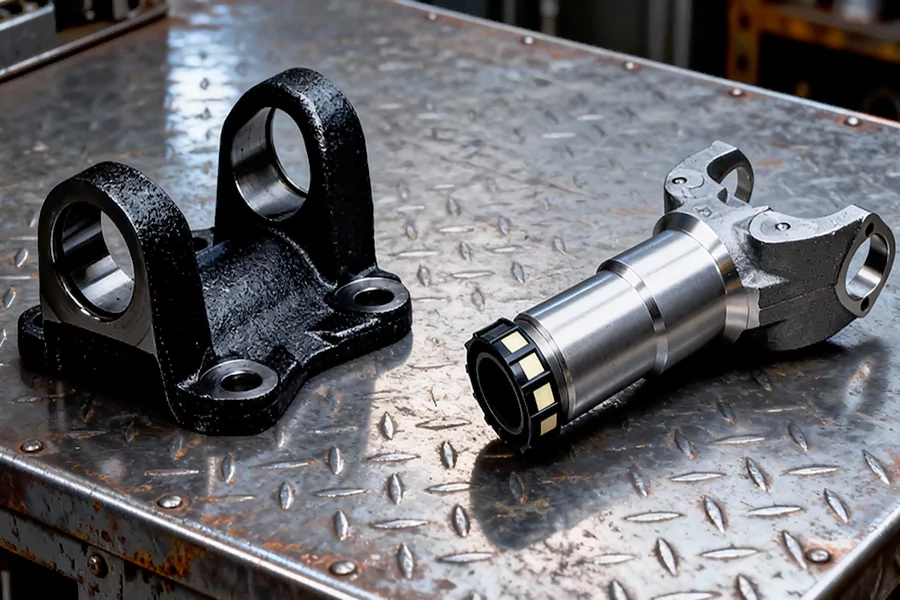
Pros and Cons Comparison
Slip Yoke
Best For
Standard cars, SUVs, and trucks
Vehicles with factory or mild suspension lifts
Pros
Allows driveshaft length changes
Reduces stress on the drivetrain
Simple, factory-style design
Cons
Splines and seals can wear over time
Less suitable for extreme suspension lifts
May contribute to vibration in high-angle applications
Flange Yoke
Best For
Heavy-duty vehicles
Lifted trucks and off-road builds
Custom driveline configurations
Pros
Stronger and more durable
Maintains better shaft alignment
Ideal for use with Double Cardan driveshafts
Cons
Requires matching companion flange
Slightly reduces available driveshaft length
Often needs driveline redesign
The Role of a Slip Yoke Eliminator (SYE)
In lifted or off-road vehicles, the increased driveline angle can cause vibration and accelerated wear when using a traditional slip yoke. A Slip Yoke Eliminator (SYE) converts the transfer case output from a sliding slip yoke to a fixed flange or fixed yoke.
Once an SYE is installed, the vehicle can use a Flange Yoke combined with a Double Cardan (CV) driveshaft, which significantly improves driveline stability, reduces vibration, and increases overall durability in high-angle conditions.
Which One Should You Use?
Stock or Mildly Lifted Vehicles
Stick with a Slip Yoke. It provides the necessary length compensation and works reliably in everyday driving conditions.
Lifted Trucks and Off-Road Vehicles
Choose a Flange Yoke, typically paired with an SYE and a Double Cardan driveshaft. This setup handles steeper angles and higher torque loads more effectively.
Strength and Simplicity Priority
If axial movement is handled elsewhere in the driveline and maximum durability is required, a Flange Yoke is the superior choice.
Selection Checklist
Before choosing between a slip yoke and a flange yoke, consider:
Suspension travel and lift height
Required torque capacity
Available driveshaft length and space
U-joint type and operating angles
Intended vehicle use (daily driving, towing, off-road, commercial duty)
These factors directly influence which yoke style will deliver the best performance and service life.
Maintenance Considerations
Slip Yoke:
Regular lubrication of the splines and inspection of the output seal help prevent wear and driveline vibration.Flange Yoke:
Ensure proper bolt torque and flange alignment. When used with Double Cardan shafts, driveline angles should be checked after installation.
Final Thoughts
There is no universally “better” option—only the right choice for your application.
Use a Slip Yoke for simplicity and flexibility in standard driveline systems.
Choose a Flange Yoke when strength, durability, and driveline control matter more than sliding capability.
About HZSP
HZSP supplies a full range of Slip Yoke and Flange Yoke solutions for automotive and industrial driveline applications. From factory-style replacements to heavy-duty and custom configurations, HZSP supports customers with reliable components and practical engineering guidance. Whether you are maintaining a standard vehicle or building a reinforced driveline for demanding conditions, HZSP can help you select the right yoke configuration to match your performance and durability requirements.