
How to Prevent U-Joint Failure?
In driveline systems, the U-joint is a small part with a big responsibility. But under certain conditions, it can fail in a very specific and avoidable way: cracking through the lube fitting hole. This usually doesn’t happen by chance. In fact, it’s often the result of incorrect installation.
When a U-joint is positioned incorrectly on the driveshaft, the torque applied during rotation can place stress in the wrong direction—pulling rather than pushing against the area around the lube fitting. Over time, that repeated tension can cause the joint to fracture right through the hole. To avoid this, the fitting should be installed in a way that lets the torque compress the hole, not stretch it.
Let’s say your driveshaft rotates clockwise when viewed from the driving end. In that case, the lube fitting should sit at roughly a 45-degree angle to the right—think of it pointing toward the northeast. This small adjustment in orientation can make a big difference in the long-term performance of your driveline components.
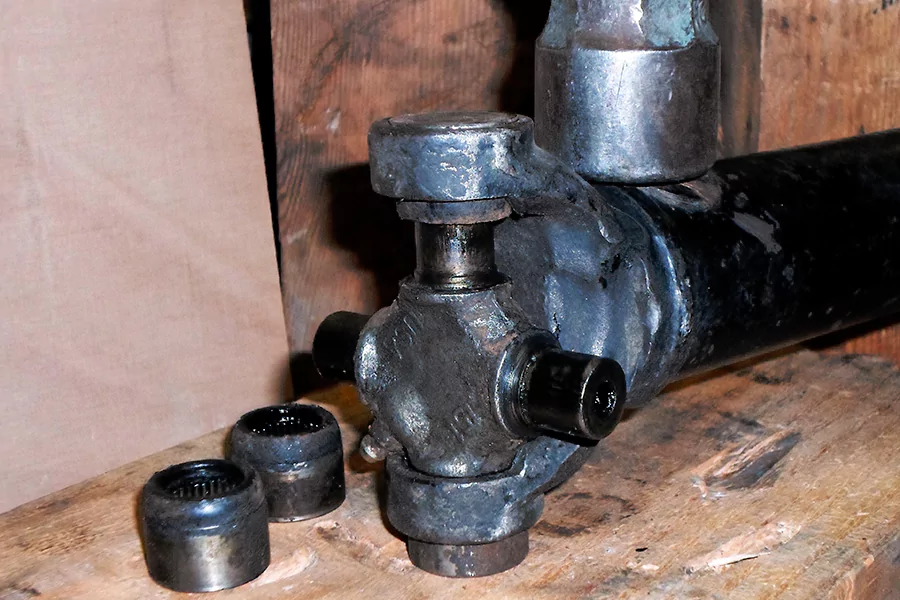
Poor Lubrication: The Hidden Cause Behind Most Driveshaft Failures
While installation errors are one part of the equation, lubrication-related issues are even more common—and often overlooked. Many U-joint and slip yoke failures trace back to simple maintenance problems: either the grease isn’t applied correctly, or the wrong product is used altogether.
What happens when lubrication is done poorly? You might see signs like metal fatigue, pitting, or even scorched trunnions due to heat buildup. These are all symptoms of parts running without enough protection.
The key here is proper purging. When greasing a U-joint, for example, you should see fresh grease coming out of all four seals. If that doesn’t happen, old grease and contaminants may remain inside. For slip yokes, grease should be added until it exits both the vent hole and the seal. Skipping this step or rushing through it will eventually lead to trouble.
Choose the Right Grease—and Don’t Skip Maintenance
It’s easy to overlook grease as just another maintenance item, but in a driveline setup, the right lubricant makes a big difference. U-joints and other driveshaft parts rely on consistent, high-quality lubrication to handle stress and keep moving freely. In most cases, a Grade 2 grease with EP (extreme pressure) additives is the way to go—designed to hold up across a wide temperature range, from well below freezing to over 300°F.
Using the wrong type of grease—or mixing incompatible ones—might not cause immediate problems, but over time, it compromises protection. That leads to faster wear, unnecessary friction, and eventually, early failure of key components.
Equally important is the timing of your lubrication routine. How often should you re-grease the system? It really depends on the working environment. For vehicles in regular road use, servicing every three months may be sufficient. On the other hand, equipment used in tough industrial conditions might need attention every 200 hours of operation—or even sooner in extreme cases.
Bringing It All Together
Keeping your driveline in top shape isn’t about complicated fixes—it’s about consistency. When U-joints are aligned correctly, lubrication is done properly, and service intervals are respected, the system tends to take care of itself. Staying ahead with routine maintenance doesn’t just protect your parts—it protects your productivity.