
How Shock Loads Cause Driveshaft Failures
When a driveshaft suddenly shears or cracks, it’s almost always the result of an unexpected jolt—or what we call a shock load—transmitting straight through the driveline. In everyday driving, these abrupt loads can happen more often than you’d think: for example, repeatedly slipping the clutch under heavy load, flooring the accelerator only to have spinning tires bite the pavement, or tugging away from a trailer whose brakes are still on. Over time, those sudden impacts strain every driveshaft component—from the tube yoke all the way through to the universal joint.
How Shock Loads Damage Driveshaft Components
First off, shock loads occur whenever mating yokes collide because of improper operating angles or an excessively stiff driveline. If the yoke angles aren’t closely matched, the two halves will “bump” against each other as the suspension moves. Similarly, sending more torque through a yoke than it’s rated for will eventually overstress its ears or welds. Instead, always choose yokes specified for your torque requirements and check that operating angles at both ends stay within recommended limits.
Typical Fracture Points
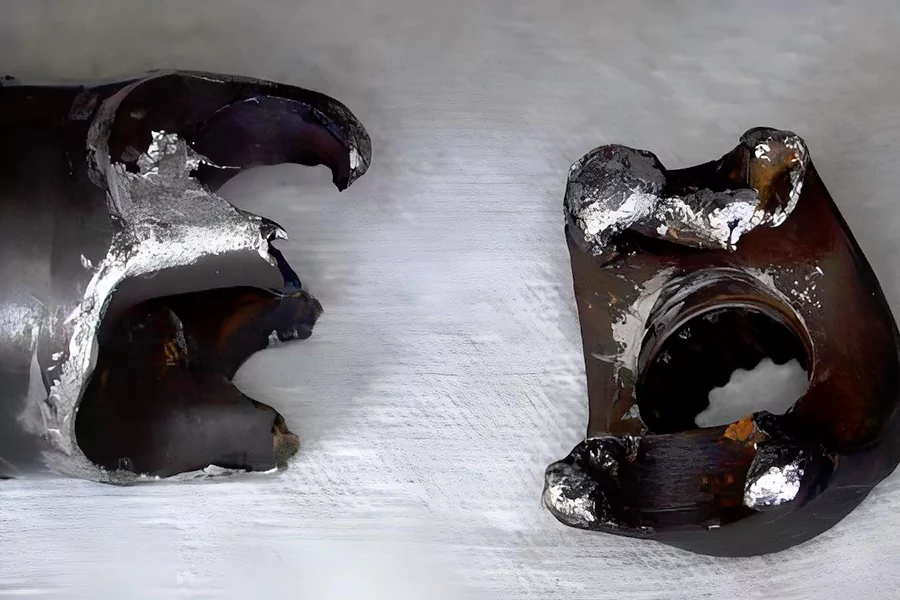
Across a driveshaft assembly, you’ll often see three main fracture areas:
- Tube yoke(Weld Yoke): Faulty weld beads, especially when they’re misaligned with the ear, invite fatigue cracks. As a rule of thumb, start your circle welds in line with the yoke ear and avoid overlapping the tube weld seam by keeping them 180° apart.
- Slip yoke: If it’s not centered in its mid-slip position or installed incorrectly, stress concentrates at the end of the spline and leads to cracks. Whenever you adjust drive-shaft length, make sure the slip yoke remains within its optimal travel range.
- End yoke: Loose bearing-strap bolts or sloppily handled U-joints let the caps rotate in their pockets. That rotation wears away material, upsets alignment, and ultimately fractures the tangs. A new strap always stretches to lock down the bearing, so don’t try to reuse old hardware once it’s torqued.
Center Bearing and Pillow Block Failures
Another vulnerable spot is the center support bearing (or pillow block). High operating angles at the front coupling generate “secondary couple loads” twice every revolution, bending the driveshaft like a bow. Because the ends are rigidly bolted, the bending force shifts into the rubber cushion—wearing it out until it crumbles. You’ll know it’s time for inspection if you spot black rubber dust around the bearing. To prevent this, keep the drive-end angle under 1.5° and swap in a solid-rubber support if you’re running a heavy-duty, thick-walled tube that would otherwise compress standard cushions.
When the Tube Itself Gives Way
Tube failures fall into two flavors. Sudden, torsional twist‐offs happen under shock loads much like yoke breakage does, and you’ll sometimes see the entire shaft spiral apart. More commonly, though, fatigue cracks form along the circular weld and gradually work around the circumference—especially if you’ve welded balance weights too close to the seam. To avoid this:
- Align circle welds precisely and start each bead opposite the tube seam.
- Keep your U-joint angles below 3° to minimize torsional vibration.
- Plus, calculate the shaft’s critical speed so you never push it near its whipping point.
Universal Joint Wear and Failure Modes
Finally, the U‐joint itself goes through its own stages of wear:
- Brinelling: Needle-bearing marks embossed into the cup, caused by over-torque, a bent yoke, or overtightened U-bolts.
- Spalling: Flaking or pitting on the bearing surface, often the result of water ingress or wrong lubricant.
- Burned cross: Darkened trunnions from insufficient grease purging at the seals.
- End galling: Material carved from the trunnion ends when angles exceed 3° or lubrication is poor.
- Complete fractures: These occur under extreme shock or torque loads when an undersized U-joint is used.
Bringing It All Together
By matching the right driveshaft components to your application—oversized yokes for high torque, proper-angle U-joints, solid center bearings for heavy‐duty shafts—and sticking to recommended torque specs and service intervals, you can drastically reduce the chance of a catastrophic failure. Regular inspections, correct welding practices, and using parts rated for your specific torque and angle conditions are the keys to keeping your driveline spinning smoothly mile after mile.